

Are Infrared Sauna Blankets Worth It? (2026 Review)
Table of Contents
- Infrared Sauna Blankets: The $500 Question
- Infrared Sauna Blanket Benefits: What the Heat Actually Does
- How to Use a Sauna Blanket: Session Guide and Safety Rules
- Sauna Blanket vs Infrared Sauna: Heat Intensity and EMF Compared
- Longevity and Durability: When a Blanket Wears Out
- Who Should Skip the Blanket and Buy a Full Sauna Instead
- The Verdict: Is a Sauna Blanket Worth It for You?
- Frequently Asked Questions
Last Updated: September 8, 2026
Infrared Sauna Blankets: The $500 Question
Are infrared sauna blankets worth it? The short answer is yes, for many people, but only if you understand exactly what you are buying. An infrared sauna blanket is a wearable, zippered wrap embedded with far-infrared heating panels that raise your core body temperature to induce sweating while you lie down. At Freedom Fit Fuel, we sell home recovery equipment and get asked this constantly, so we broke down the real costs, benefits, and limitations.

The core appeal is obvious: a full sauna room costs thousands and eats up floor space, while a blanket costs a few hundred and rolls up into a closet. But that convenience comes with trade-offs in heat intensity, durability, and the overall experience. Below we show you exactly how to decide if a blanket fits your routine or if you are better off saving for a full unit.
Infrared Sauna Blanket Benefits: What the Heat Actually Does
Infrared heat therapy works differently from a traditional steam room. Instead of heating the air around you, far-infrared radiation penetrates the skin and heats your body tissue directly, promoting vasodilation and increased blood circulation (peer-reviewed research). Many users report that regular sessions support muscle recovery, cardiovascular health, and a noticeable reduction in stress levels, as the heat encourages endorphin release.
The most commonly cited infrared sauna blanket benefits include detoxification through heavy sweat production, temporary relief from joint stiffness, and skin rejuvenation. What you should not expect is dramatic weight loss or a medical cure-all. The sweat you lose is mostly water weight, and while your metabolic rate does rise during a session, the effect is modest. The real value is in recovery and relaxation.
How to Use a Sauna Blanket: Session Guide and Safety Rules
Using a sauna blanket is straightforward, but safety rules matter more than with a full sauna because you are lying down with heat directly against your body. Start by pre-heating the blanket for 5 to 10 minutes, then wrap yourself in a moisture-wicking base layer to protect your skin. Lie flat, set your session to 30 to 45 minutes, and keep a towel and water bottle within reach.
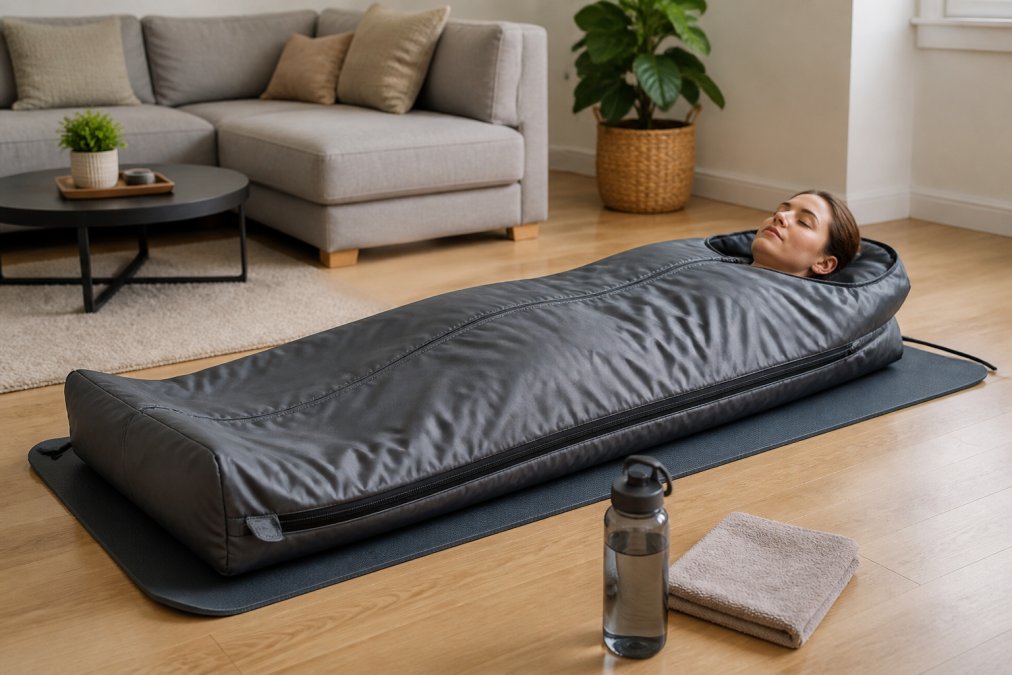
Hydration is non-negotiable. You will sweat heavily, so drink water before and after each session. Start at a lower temperature for your first few uses to build heat tolerance, and never fall asleep inside the blanket. A common mistake is cranking the heat to maximum immediately, which can cause overheating or discomfort. Listen to your body and step out if you feel dizzy or nauseous. Always check the manufacturer's contraindications before use.
Sauna Blanket vs Infrared Sauna: Heat Intensity and EMF Compared
The sauna blanket vs infrared sauna comparison comes down to two factors: heat intensity and electromagnetic fields. A full sauna cabin, like the Barcelona FAR Infrared Home Sauna we carry, reaches up to 135F with 6 low-EMF carbon panels rated between 5-10 mg measured 2-3 inches from the panel (the FDA). A blanket traps heat closer to your body, which can make you sweat faster, but it typically does not reach the same ambient temperatures or deliver the same even, full-body heat distribution.

EMF exposure is where blankets face more scrutiny. Because you are in direct contact with the heating elements, the distance between you and the source of electromagnetic fields is minimal. Full saunas with low-EMF panels give you more physical separation, which reduces exposure levels. If EMF is a concern, look for products that explicitly state low-EMF ratings, and consider a full unit for greater peace of mind.
What EMF Ratings Actually Mean
Most buyers see "low EMF" on a spec sheet and assume it means zero, but that is not how electromagnetic fields work. Every electrical device emits some level of EMF, and the relevant question is how much exposure you are getting at the distance your body sits from the source. In a full sauna, carbon heating panels are typically mounted behind wooden slats, placing them 2 to 4 inches from your skin. In a blanket, the heating elements are separated from your body only by a thin layer of fabric and whatever base layer you choose to wear.
A common pattern among manufacturers is to report EMF readings taken at 6 to 12 inches from the panel surface, which makes numbers look lower than what you would experience in practice. When comparing products, look for the measurement distance in the fine print. A rating of 5 mg measured at 3 inches is meaningfully different from the same rating measured at 12 inches. If a manufacturer does not disclose the measurement distance, treat the claim with skepticism.
Temperature Reach: Blanket vs. Professional-Grade Sauna
Heat intensity is not just about the thermostat setting. A full sauna heats the air around you, so your entire body is exposed to a consistent ambient temperature. A blanket heats only the surfaces in direct contact with the heating panels, meaning your sides, arms, and the back of your head may not receive the same level of heat as your torso.
Most infrared sauna blankets on the market reach internal temperatures between 120F and 140F at the heating element surface. However, the temperature you actually feel depends on the insulation layer, the fabric between you and the element, and how tightly you wrap yourself. A loosely wrapped blanket loses heat quickly, while a snug wrap traps more warmth but also increases the risk of localized overheating.
Professional-grade infrared saunas, by contrast, maintain ambient temperatures of 120F to 150F throughout the cabin, with the air itself carrying the heat. This means more uniform heating across your entire body, including areas not pressed directly against a panel. For users who want deep, even heat distribution, the full sauna has a clear advantage. For users who want targeted heat on a specific muscle group, a blanket's direct contact can actually be more effective.
The EMF Trade-Off in Practical Terms
The practical difference in EMF exposure between a blanket and a full sauna is a matter of distance and duration. A 30-minute session in a blanket keeps your body in direct contact with the heating elements for the entire time. A 30-minute session in a full sauna keeps you several inches away from the panels, and the air gap provides natural attenuation of the electromagnetic field.
If you are sensitive to EMF or simply want to minimize exposure as a precaution, a full sauna with low-EMF panels is a choice to consider. If you are comfortable with the exposure levels of everyday electronics like heating pads or electric blankets, a sauna blanket falls into a similar category. The key is to read the specifications carefully and understand what the manufacturer is actually claiming.
| Feature | Sauna Blanket | Full Infrared Sauna |
|---|---|---|
| Starting Price | $499.50 | $2,359.99+ |
| Heat Intensity | Direct contact, lower ambient | Up to 135F, even distribution |
| EMF Exposure | Higher due to contact | Lower with low-EMF panels |
| EMF Measurement Distance | Often undisclosed | Typically 2-3 inches from panel |
| Space Needed | Rolls up for storage | 39 x 36 x 73 inches permanent |
| Session Experience | Lying flat, solo | Seated, more spacious |
Longevity and Durability: When a Blanket Wears Out
A sauna blanket is not a lifetime purchase. The heating wires and synthetic outer layers degrade with repeated use, especially if you do not maintain them properly. Most manufacturers expect a lifespan of 1 to 3 years with regular sessions, depending on build quality. The zippers and internal wiring are the first failure points, and once the heating elements short out, the blanket is usually not worth repairing.
Hygiene maintenance also affects durability. You sweat directly onto the interior, so wiping it down after every use and letting it air dry completely is essential to prevent mold and material breakdown. A blanket with independently adjustable heat zones, like the 3-Zone Infrared Sauna Blanket from Freedom Fit Fuel, gives you more control over which areas get heated, which can reduce strain on the system over time. A full wooden sauna, by contrast, has no electronics in contact with your body and can last for many years with basic care.
What Happens After 100 Sessions
Most reviews are written after a few weeks of use, when the blanket still feels new. The real durability test comes after 100 or more sessions, which is roughly 3 to 4 months of daily use or 6 to 8 months of use every other day. At that point, several predictable failure patterns emerge.
The interior lining is the first component to show wear. Constant exposure to sweat, even with a base layer, causes the synthetic fabric to break down and become less effective at reflecting heat back toward your body. You may notice the blanket takes longer to reach its maximum temperature or that certain zones feel weaker than others. This is not a malfunction; it is the natural result of the insulating layer compressing and losing its thermal reflectivity.
The zipper is the second most common failure point. The repeated stress of zipping and unzipping while the blanket is folded or twisted puts strain on the zipper track. Once the zipper teeth misalign, the blanket no longer seals properly, meaning heat escapes and your session becomes less effective. Replacing a zipper on a sauna blanket is rarely cost-effective, since the labor cost often approaches the price of a new blanket.
The heating wires themselves are the third risk area. These wires are embedded in flexible panels that bend every time you roll up the blanket for storage. Over time, the repeated flexing can cause micro-fractures in the wire connections, leading to cold spots or complete failure of a heating zone. This is why proper storage matters: rolling the blanket loosely rather than folding it sharply reduces stress on the internal wiring.
How to Extend the Lifespan of Your Blanket
A few simple habits can push a blanket from the 1-year mark toward the 3-year mark. First, always use a moisture-wicking base layer. This is not just for comfort; it creates a barrier between your sweat and the interior fabric, which is the primary cause of material degradation. Second, let the blanket cool down completely before rolling it up. Storing a warm blanket traps heat and moisture inside, accelerating breakdown of both the fabric and the adhesive that holds the heating panels in place.
Third, wipe down the interior after every session with a damp cloth and a mild cleaner, then leave it unzipped and open to air dry for at least 30 minutes before storage. Fourth, avoid sitting or placing heavy objects on the blanket when it is not in use, as this can compress the heating panels and create pressure points that lead to uneven heat distribution.
Cost Per Session: The Real Math
When you calculate the cost per session over the life of the blanket, the value proposition becomes clearer. A $499.50 blanket that lasts 2 years with 3 sessions per week delivers roughly 312 sessions, putting the cost at about $1.60 per session. If the blanket lasts only 1 year, the cost doubles to about $3.20 per session. A full sauna at $2,359.99 with a 10-year lifespan and the same 3 sessions per week delivers roughly 1,560 sessions, putting the cost at about $1.51 per session.
The math shows that a full sauna can be more cost-effective over the long term if you maintain a consistent routine. The blanket wins on upfront cost and portability, but it is a consumable product. If you are planning to use infrared heat for years rather than months, the full sauna can be a better investment on a per-session basis.
Signs That It Is Time to Replace Your Blanket
Do not wait for a complete failure before replacing your blanket. Watch for these warning signs: uneven heating across zones, a burning smell during use, visible fraying or discoloration of the interior fabric, or a zipper that sticks or catches. Any of these indicates that the blanket is no longer operating safely or effectively. Continuing to use a degraded blanket increases the risk of overheating or electrical issues, and the reduced heat output means you are not getting the full benefit of your session.
Who Should Skip the Blanket and Buy a Full Sauna Instead
A sauna blanket makes sense for renters, apartment dwellers, and anyone who wants infrared heat therapy without dedicating permanent floor space. If you live in a smaller apartment and storage is your main constraint, a blanket that rolls up is the practical choice. It is also the lower-cost entry point for testing whether infrared heat fits your routine.
You should skip the blanket and buy a full sauna if you value heat intensity, plan to use it daily for years, or want a shared experience. Full saunas offer higher and more even temperatures, lower EMF exposure, and a more comfortable seated session. For couples or anyone with space in a home gym, the Extendable Infrared Sauna slides to save up to 5 sq ft of floor space when not in use, offering a middle ground between a blanket and a permanent cabin.
The Verdict: Is a Sauna Blanket Worth It for You?
Are infrared sauna blankets worth it? For most people new to infrared heat therapy, yes, a blanket is a reasonable starting point. The 3-Zone Infrared Sauna Blanket at $499.50 delivers the core benefits of infrared heat, including muscle recovery and stress reduction, at a fraction of the cost of a full sauna. It is portable, easy to store, and lets you build a consistent habit without a major installation.
The blanket is not worth it if you already know you want serious, long-term heat therapy. In that case, the $2,359.99 Barcelona FAR Infrared Home Sauna offers lower EMF exposure, higher temperatures, and a build that will outlast several blankets. Whatever you choose, go in with clear expectations: infrared heat supports recovery and relaxation, but it is not a miracle cure.
Choosing between a sauna blanket and a full sauna comes down to your space, budget, and how seriously you plan to use the heat. If you are still unsure, start with the blanket to build the habit, then upgrade when you know the routine sticks. Freedom Fit Fuel carries both options, from the customizable 3-Zone Infrared Sauna Blanket to low-EMF full saunas, all with real inventory and direct pricing. Find the infrared setup that fits your home and your recovery goals.
Frequently Asked Questions
What are the disadvantages of an infrared sauna blanket?
The main disadvantages are the confined lying position, lower maximum heat compared to a wooden sauna, and the fact that heat mostly targets the back and front of the torso rather than surrounding the whole body. Durability is also a factor, since the heating elements and zippers face wear from regular rolling and folding. You also miss out on the upright, social or meditative space a full sauna cabin provides.
Are infrared blankets as effective as saunas?
For muscle recovery and sweat production, a blanket can be effective because both use far-infrared radiation to raise core body temperature. The difference is intensity and coverage. A full infrared sauna surrounds you with multiple carbon heating panels, so your arms, legs, and back heat evenly. A blanket presses against your body, which can feel hotter in spots but leaves your head, neck, and feet outside the heat zone.
How many times a week should you use an infrared sauna blanket?
Most people start with 2 to 3 sessions per week at 20 to 30 minutes each. This gives your cardiovascular system time to adapt to the heat stress. If you tolerate that well, you can work up to 4 sessions weekly. More frequent use does not speed up results, and it increases fluid loss, so you need to replace electrolytes. Listen to your body and skip a day if you feel lightheaded or overly fatigued.
Do sauna blankets actually help reduce cortisol levels?
Research on heat therapy shows that raising your core body temperature triggers a relaxation response that can lower cortisol and stimulate endorphin release. The effect is tied to the heat stress itself, not the specific device. A 20-minute session in a blanket that gets you sweating can produce this response. The key is consistency and using it in a calm environment rather than treating it as a quick fix.