

How to Verify Red Light Intensity at Home
Table of Contents
- Why Most Red Light Claims Fall Short of Reality
- Red Light Therapy Irradiance Measurement: Know Your mW/cm²
- How to Test Red Light Wavelength Accuracy in nm
- Red Light Therapy Power Density Explained: The Dosage Question
- Affordable Tools to Verify Red Light Intensity at Home
- Troubleshooting Common Measurement Errors
- How to Interpret Your Results and Adjust Your Sessions
- Frequently Asked Questions
Last Updated: September 9, 2026
Why Most Red Light Claims Fall Short of Reality
Red light intensity is the single most important factor in whether your therapy session actually works, yet it is also the specification most often misunderstood or simply omitted by manufacturers. Many home devices advertise impressive LED counts while staying vague about the actual light output you receive at your skin. This guide walks you through the practical steps to verify red light intensity so you can trust your investment and your sessions.

Most guides get this wrong because they assume the panel's advertised wattage tells you what you need to know. It doesn't. The number of LEDs and total electrical draw tell you almost nothing about the therapeutic light that reaches your body. What matters is the irradiance measured at your skin, expressed in milliwatts per square centimeter (mW/cm²), and the wavelength accuracy in nanometers (nm).
Below, we'll show you exactly how to measure both at home, which tools are worth your money, and how to interpret the numbers so you can adjust your sessions with confidence.
Red Light Therapy Irradiance Measurement: Know Your mW/cm²
Red light therapy irradiance measurement is the process of quantifying the optical power delivered to a surface area, typically reported as mW/cm². This figure tells you how much energy is hitting your skin per second, which directly determines your treatment time.

The clinical research that established red light therapy's benefits generally uses irradiance values in a specific therapeutic range (peer-reviewed research). If your device delivers far less than that, you would need impractically long sessions to accumulate a meaningful dose. If it delivers far more, you risk overheating the skin without additional benefit.
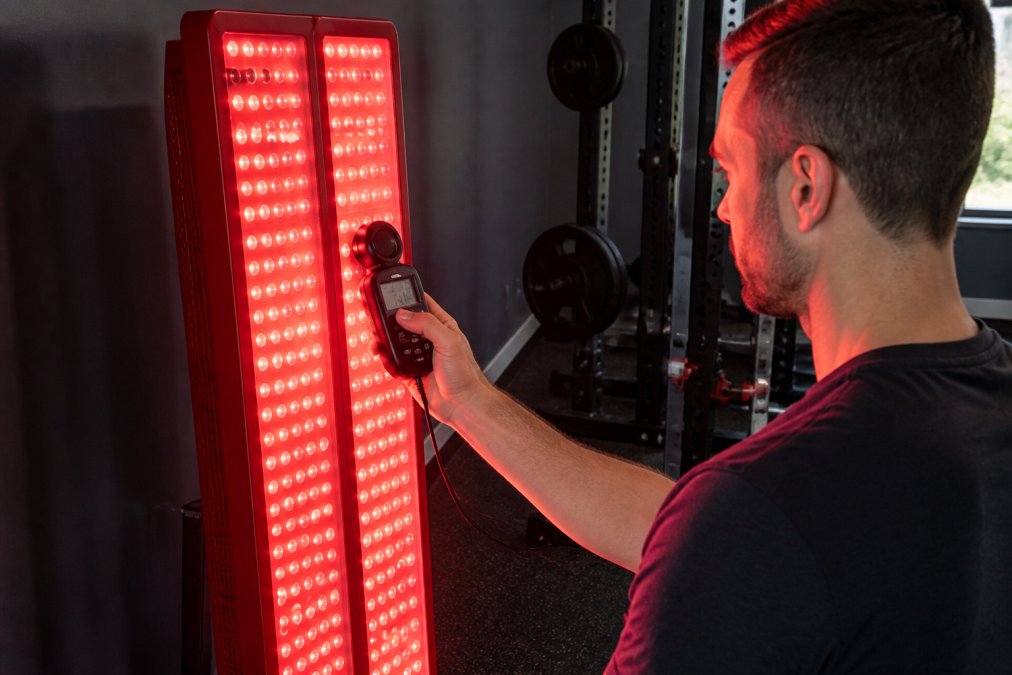
To measure irradiance at home, you need a sensor placed at the exact distance you plan to use during treatment. Move the sensor closer and the number rises; move it further and it drops. A common mistake is testing right against the panel surface, where readings look impressive, then treating from 12 inches away where the actual red light intensity has dropped significantly.
How to Test Red Light Wavelength Accuracy in nm
Wavelength accuracy determines whether the light penetrates to the right depth in your tissue. Red wavelengths around 660nm target the skin surface, while near-infrared around 850nm penetrates deeper into muscles and joints (PubMed). A device that claims 660nm but actually emits 640nm or 680nm is delivering a different treatment entirely.
Testing wavelength requires a spectrometer, which uses a diffraction grating to separate light into its component colors. This light dispersion allows the device to identify the peak emission wavelength and show you the full spectral analysis of your panel. Without one, you are trusting the manufacturer's label on faith.
The visible spectrum ends around 700nm, so the red and near-infrared bands you care about require a sensor sensitive beyond what your eyes can see. Your phone camera cannot verify this, which brings us to the practical tools.
Red Light Therapy Power Density Explained: The Dosage Question
Red light therapy power density explained simply: it is the irradiance (mW/cm²) multiplied by your session time in seconds, giving you a total energy dose in joules per square centimeter (J/cm²). This is the dosage figure that clinical protocols reference.

Most therapeutic protocols aim for a dose somewhere in the range of 3 to 50 J/cm² depending on the condition being treated. To calculate your dose, you multiply your measured irradiance by your session duration. For example, if your panel delivers 50 mW/cm² at your treatment distance, a 10-minute session gives you roughly 30 J/cm².
The relationship between intensity and time is the key insight. A lower-powered panel is not necessarily useless; it just requires longer sessions to hit the same dose. This is why verifying red light intensity matters more than chasing the highest advertised number.
Affordable Tools to Verify Red Light Intensity at Home
You do not need a laboratory to verify red light intensity. Several affordable options exist, each with trade-offs in accuracy and cost. The right choice depends on how much precision you need and what you are willing to spend.
What a Spectrometer Actually Tells You
A dedicated spectrometer is the gold standard for verifying both wavelength and relative intensity. These devices use a diffraction grating to analyze the full light emission spectrum, showing you the exact peak wavelength and the shape of the emission curve. Entry-level units cost a few hundred dollars and connect to your phone for instant readouts.
The limitation is that most consumer spectrometers measure relative intensity, not absolute irradiance. They tell you where the peak is and how clean the emission is, but they do not directly give you mW/cm² at your skin. For that, you need a separate radiometer or a spectrometer calibrated for photometric measurement.
The Smartphone App Shortcut and Its Limits
Smartphone apps that claim to measure light output are appealing because they are free, but they have fundamental limitations. The phone's ambient light sensor is designed for screen brightness, not precision measurement of therapeutic light. It cannot distinguish between wavelengths, so it cannot verify nm accuracy at all.
The apps can serve one useful purpose: relative comparison. If you change your distance or angle and the reading changes consistently, you can map the beam pattern of your panel. That helps you find the sweet spot for treatment, but treat any absolute mW/cm² number from a phone app with deep skepticism.
Troubleshooting Common Measurement Errors
Measurement errors are common, and most stem from a few fixable mistakes. Ambient light interference is the biggest culprit. Sunlight and indoor lighting contain infrared energy that will skew your readings upward. Measure in a dark room or shield the sensor from ambient sources.
Sensor calibration drifts over time, especially for low-cost units. If your readings suddenly change for no reason, check the calibration. Some sensors can be recalibrated against a known reference source, while others simply need to be replaced.
Another common mistake is averaging readings across the entire panel surface. Most panels have an uneven beam pattern, with hotspots directly over the LEDs and dimmer areas between them. Measure at several points across the treatment area and use the lowest reading to set your session time.
How to Interpret Your Results and Adjust Your Sessions
Once you have your measurements, the interpretation is straightforward. If your panel delivers a reasonable irradiance at your treatment distance and emits at the claimed wavelengths, you can trust the device and focus on consistent use.
If the numbers fall short, adjust your distance first. Moving closer to the panel dramatically increases irradiance, following the inverse square law. Many users find they need to sit closer than the marketing photos suggest to reach the therapeutic range.
Your session time should be calculated from your measured irradiance, not from the manufacturer's suggested duration. Use the dose formula to determine how long you need to reach a clinically meaningful target. If your measured output is genuinely too low to reach a useful dose in a reasonable time, the honest conclusion is that the device may not be suitable for your goals.
| Measurement | Tool | What It Tells You | Typical Cost |
|---|---|---|---|
| Wavelength (nm) | Spectrometer | Peak emission accuracy | $200-$500 |
| Irradiance (mW/cm²) | Radiometer | Power at your skin | $150-$400 |
| Beam pattern | Smartphone app | Relative hot/cold spots | Free |
Verifying your red light therapy panel is a one-time investment of an hour and a few hundred dollars that pays off in every future session. At Freedom Fit Fuel, we believe you should know exactly what your equipment delivers, which is why we are transparent about the specifications of our red light therapy panels, from the FDA device classification guidance down to the LED wavelength ratings. Our panels are built for measurable results, and we are happy to talk through the numbers with you before you buy. Get started with Freedom Fit Fuel and bring real, verifiable light therapy into your home routine.
Frequently Asked Questions
How can I tell if my red light therapy device is actually working?
The most reliable way is to measure its output with a spectrometer or a dedicated light meter. A spectrometer confirms the wavelength matches the claimed nanometers, while a power meter measures irradiance in mW/cm². If a device claims 660nm but reads 620nm, it's not delivering therapeutic red light. Compare your readings at the distance you actually use the device, since intensity drops sharply as you move away.
What is the difference between irradiance and wavelength in red light therapy?
Wavelength, measured in nanometers (nm), determines where the light penetrates and what biological effects it triggers. Irradiance, measured in mW/cm², tells you how much light energy reaches your skin per second. Think of wavelength as the type of tool and irradiance as the power behind it. Both matter for red light therapy power density, which is the total dose you receive over a session.
Can a smartphone app accurately measure red light intensity?
Smartphone apps can give you a rough idea, but they are not accurate enough for verification. Phone cameras lack the calibrated sensors and optical filters needed for precise spectral analysis or irradiance measurement. They are useful for comparing a device against itself over time, but don't rely on them to confirm clinical-level output. A basic spectrometer or light meter is a better investment if you want trustworthy data.
What equipment do I need to verify red light therapy output?
You need two tools for a complete check: a spectrometer to verify the wavelength in nanometers and a power meter to measure irradiance in mW/cm². A basic spectrometer costs roughly $100 to $200. For a simpler approach, a dedicated red light meter that measures both irradiance and power density can work, though it may not give you the full spectral picture.