

Sleep Quality and Chronic Inflammation: What Helps
Table of Contents
- The Bidirectional Relationship Between Sleep and Inflammation
- The Bidirectional Relationship Between Sleep and Inflammation
- Signs of Chronic Inflammation You Might Be Ignoring
- What the Research Says About Sleep Duration, Sleep Quality, and Inflammatory Markers
- How to Reduce Systemic Inflammation Through Better Sleep Habits
- Red Light Therapy for Inflammation: Can It Support Recovery While You Sleep?
- When Poor Sleep Is a Clinical Concern, Not Just a Bad Habit
- Conclusion
- Frequently Asked Questions
Last Updated: September 10, 2026
The Bidirectional Relationship Between Sleep and Inflammation
Sleep quality and chronic inflammation run in both directions: poor sleep raises inflammatory markers, and those markers fragment your sleep. This guide covers the research, the warning signs that matter, and how to reduce systemic inflammation.
Chronic inflammation is persistent, low-grade immune activation that lingers for months or years instead of resolving, quietly damaging tissue over time.
Most advice treats sleep as a symptom to manage rather than a lever to pull. That's backwards. The [CDC overview of sleep and(/blogs/news-that-fuels-your-freedom-journey/anti-inflammatory-meal-prep-busy-professionals) chronic disease | cdc.gov] notes that insufficient sleep is linked to a range of chronic health conditions, and inflammation sits near the center of that relationship.
The Bidirectional Relationship Between Sleep and Inflammation
Sleep and inflammation regulate each other through the same immune signaling pathways; disrupt one and the other follows within days.
How Sleep Deprivation Triggers an Immune Response
Sleep deprivation is a stressor, and the body responds like it would to any threat: the immune system releases pro-inflammatory cytokines to coordinate repair, but with ongoing sleep loss that response never shuts off.
Even a single night of acute sleep loss can shift circulating inflammatory markers upward, the system is that sensitive.
How Inflammatory Markers Disrupt Sleep Architecture
The relationship also reverses: elevated cytokines interfere with sleep architecture, the normal cycling between light, deep, and REM stages. Deep sleep is when much of the body's repair and immune regulation happens.
When inflammation keeps you in lighter stages, you wake unrefreshed, fatigue drives more stress, and inflammation rises further. Breaking the loop means addressing both ends.
Signs of Chronic Inflammation You Might Be Ignoring
Persistent fatigue tops the list, tiredness sleep doesn't fix, often blamed on a busy schedule.
Other signs worth paying attention to:
- Joint stiffness or achiness in the morning that eases as the day goes on
- Brain fog or difficulty concentrating in the afternoon
- Digestive discomfort that comes and goes without a clear trigger
- Skin flare-ups, rashes, or unexplained breakouts
- Frequent minor illnesses or slow wound healing
- Mood changes, particularly irritability or low-grade depression
None of these signs prove anything alone. Together, especially alongside poor sleep, they're a reasonable prompt to talk to a clinician and consider blood work.
What the Research Says About Sleep Duration, Sleep Quality, and Inflammatory Markers
Duration and quality are related but distinct, and both matter: eight hours in bed still leaves you inflamed if the time was fragmented.
C-Reactive Protein, Cytokines, and What Blood Work Can Tell You
C-reactive protein (CRP) is a liver-produced protein and one of the most widely used clinical markers of inflammation. A high-sensitivity CRP test detects low-grade elevations standard tests miss: most labs flag hs-CRP under 1.0 mg/L as lower risk, 1.0-3.0 mg/L as average, and above 3.0 mg/L as higher cardiovascular risk, though a clinician interprets those bands alongside other factors (the CDC).
Cytokines like interleukin-6 and tumor necrosis factor-alpha are signaling molecules that coordinate the immune response. When these stay elevated, the body acts as if it's fighting an infection that isn't there. The National Institutes of Health research on sleep and immune function has documented these relationships across multiple study designs.
| Marker | What It Measures | Why It Matters for Sleep |
|---|---|---|
| C-reactive protein | Liver-produced inflammation protein | Elevated CRP correlates with fragmented sleep |
| Interleukin-6 | Pro-inflammatory cytokine | Rises with sleep deprivation, disrupts sleep architecture |
| TNF-alpha | Immune signaling molecule | Linked to both inflammation and daytime fatigue |
| Cortisol | Stress hormone | Disrupted circadian rhythm throws off its daily curve |
| Fibrinogen | Clotting protein and acute-phase reactant | Elevated in chronic short sleepers, tied to cardiovascular risk |
| White blood cell count | General immune activation | Shifts upward with sustained sleep restriction |
What the Study Designs Actually Show
Experimental sleep restriction. In lab protocols, healthy volunteers are kept awake or restricted to a few hours of sleep while researchers draw blood at fixed intervals. This is the strongest evidence that sleep loss causes marker changes rather than merely correlating with them: IL-6 and TNF-alpha rise, CRP rises more slowly, and the effect is larger overnight.
Observational cohort studies. Large population studies tracking sleep habits and blood markers over years consistently show that people reporting short sleep (roughly under six hours) or poor quality carry higher CRP and IL-6 than those reporting seven to eight hours. The limitation: they can't fully rule out reverse causation, inflammation may disrupt sleep as much as the reverse.
Intervention and treatment studies. When sleep apnea is treated with CPAP, or insomnia with cognitive behavioral therapy for insomnia (CBT-I), inflammatory markers often improve modestly. The improvements are real but smaller than experimental sleep-loss effects, suggesting that once inflammation is established, sleep alone doesn't fully reverse it.
Duration vs. Quality: Which Matters More?
Short and fragmented sleep overlap and reinforce each other, but show up differently in the data.
- Short duration tends to move IL-6 and TNF-alpha first, with CRP following over days to weeks.
- Fragmented quality, frequent awakenings, low slow-wave sleep, untreated apnea, tends to correlate more strongly with elevated CRP and with markers of sympathetic nervous system activation.
- Both together produce the largest and most persistent elevations, which is why people with insomnia plus short sleep tend to show the highest inflammatory burden in cohort data.
The Circadian Angle Most Articles Skip
Inflammatory markers aren't flat across the day: CRP, IL-6, and cortisol follow a 24-hour rhythm, and immune cell trafficking shifts with the light-dark cycle. The timing of sleep matters, not just total hours.
Shift workers are the clearest natural experiment: when sleep moves to the wrong circadian phase, daytime sleep for a night-shift worker, inflammatory markers rise even when total sleep time is held roughly constant. For anyone with a chronic inflammatory condition, protecting a consistent sleep window aligned with darkness is a distinct lever from sleeping longer.
Acute Sleep Loss vs. Chronic Sleep Deficiency
A single night of acute sleep loss produces a measurable but temporary spike in inflammatory markers. Most healthy people recover within a day or two of normal sleep.
Chronic sleep deficiency is different. When short or fragmented sleep continues for weeks or months, the body adapts to a permanently elevated inflammatory state, harder to reverse and more closely tied to metabolic health, cardiovascular risk, and autoimmune conditions.
How to Reduce Systemic Inflammation Through Better Sleep Habits
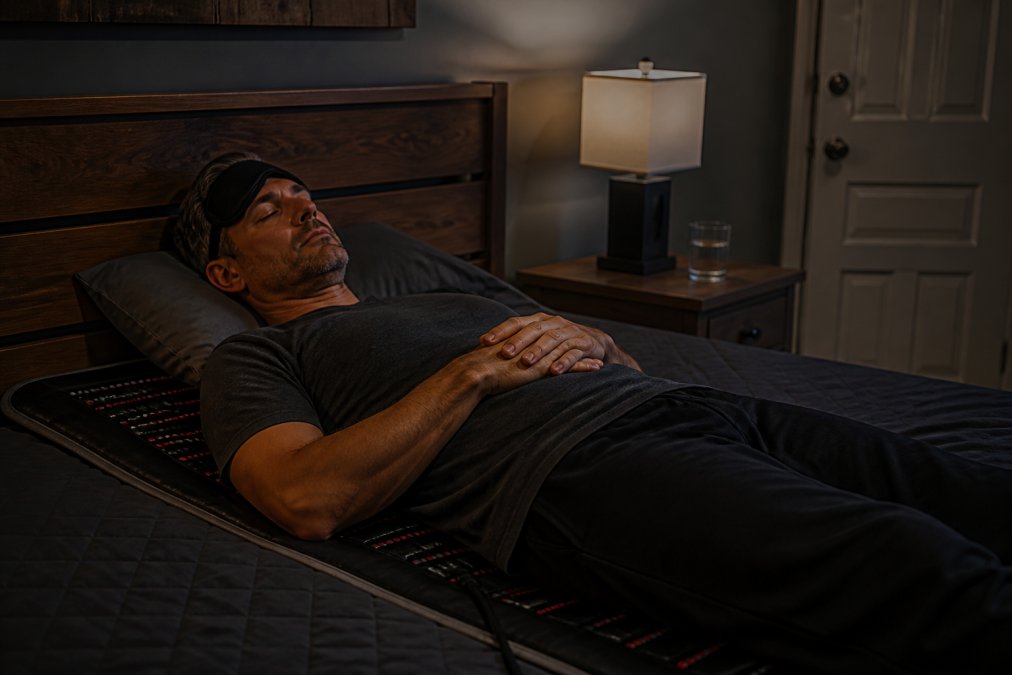
Most articles stop at "get more sleep." What follows is a practical, evidence-informed sequence to run for four to six weeks, then evaluate, especially if you're managing an inflammatory condition like rheumatoid arthritis, psoriasis, Crohn's disease, or type 2 diabetes.
Step 1: Anchor Your Wake Time Before You Touch Bedtime
Your circadian rhythm is set primarily by morning light, not bedtime, so the fastest fix is a fixed wake time, within a 30-minute window, seven days a week, weekends included.
- Pick a wake time you can actually hit on your worst day, not your best.
- Get bright light within 60 minutes of waking. Outdoor light on a cloudy day is still far stronger than indoor lighting.
- If you can't get outside, a 10,000-lux light box for 20-30 minutes is a reasonable substitute.
- Hold the wake time for at least two weeks before judging whether it's working. The rhythm takes time to consolidate.
Step 2: Build a Wind-Down That Lowers Sympathetic Activity
The goal of the last 60-90 minutes before bed is shifting from sympathetic (fight-or-flight) to parasympathetic (rest-and-digest) dominance: core temperature and adrenaline both need to fall.
A workable sequence:
- Dim household lighting two hours before bed. Overhead lights off; lamps and warm bulbs only.
- Stop caffeine by early afternoon. Caffeine's half-life is roughly five to six hours, and it blocks adenosine, the molecule that builds sleep pressure.
- Finish eating two to three hours before bed. Late meals raise core temperature and can worsen reflux, which fragments sleep.
- Take a warm shower or bath 60-90 minutes before bed. The subsequent drop in core temperature is a genuine sleep signal.
- Keep the bedroom cool, most sleepers do best between 65°F and 68°F, dark, and quiet.
- If your mind races, write tomorrow's tasks on paper. Externalizing them reduces pre-sleep cognitive arousal.
Step 3: Match Movement to Your Sleep Window
Exercise supports sleep quality, but timing matters.
- Morning or early afternoon is the safest window for vigorous training. It reinforces the circadian signal and rarely disrupts sleep onset.
- Late evening heavy training can backfire. It raises core temperature and adrenaline right when you need both to fall.
- Strength training two to three times per week plus low-intensity movement on other days is a reasonable baseline for most adults.
- If you have an active inflammatory condition, start with walking, cycling, or swimming and add resistance work gradually. Flare-ups are a signal to reduce load, not push through.
Step 4: Eat in a Way That Supports Both Sleep and Inflammation
Sleep and diet aren't separate levers. Build around these patterns:
- Mediterranean-style eating, vegetables, olive oil, fatty fish, legumes, whole grains, is the most consistently studied dietary pattern for lowering CRP and IL-6.
- Omega-3 sources (salmon, sardines, walnuts, flax) support both inflammatory balance and sleep quality in several small trials.
- Fiber and fermented foods feed gut bacteria that influence systemic inflammation.
- Alcohol is the most common self-defeating sleep aid. It shortens sleep onset but suppresses REM and fragments the second half of the night.
- Late heavy meals and high-sugar snacks raise core temperature and blood glucose, both of which disturb sleep architecture.
Step 5: Track, Then Adjust
A protocol without measurement is a guess. For four to six weeks, log:
- Wake time and lights-out time
- Estimated sleep latency (how long it took to fall asleep)
- Number of awakenings
- Subjective restedness on a 1-10 scale
- Any flare symptoms (joint pain, skin, digestive, fatigue)
If nothing moves after six weeks, or you snore heavily, wake gasping, or fall asleep during the day, see a clinician rather than adding more supplements or devices.
Diet, Movement, and Recovery Synergy
Sleep hygiene alone won't resolve systemic inflammation if diet and movement work against it: anti-inflammatory eating, moderate exercise, and adequate recovery reinforce each other.
Red Light Therapy for Inflammation: Can It Support Recovery While You Sleep?
Red light therapy for inflammation is a supporting tool, not a replacement for sleep fundamentals. Photobiomodulation, the mechanism behind red and near-infrared light therapy, is thought to influence cellular energy production and reduce oxidative stress in targeted tissue.

For home use, the practical question is whether a device delivers meaningful intensity. Freedom Fit Fuel carries the RN300 Red Light Therapy Panel for targeted sessions, and full-body options like the Infrared PEMF Pro Mat that combine far-infrared heat with pulsed electromagnetic field therapy for use during wind-down.

We're new, and we'll say so plainly: no reviews yet, no customer stories to point to. What we do have is direct pricing and real inventory on recovery equipment, plus a founder who's a U.S. Air Force veteran and owns exactly two pieces of gear on the site himself. If a home device isn't right for you, a clinician or physical therapist is the better first call.
When Poor Sleep Is a Clinical Concern, Not Just a Bad Habit
Talk to a clinician when poor sleep persists more than three months, when you snore heavily or wake gasping, or when fatigue interferes with daily function. These patterns point toward conditions like sleep apnea that need diagnosis, not lifestyle tweaks.
Clinical evidence increasingly treats sleep deficiency as a modifiable risk factor rather than a side effect of modern life. If you're managing an autoimmune or chronic inflammatory condition, sleep deserves the same attention as medication and diet.
Conclusion
Chronic inflammation rarely announces itself. It shows up as unexplained fatigue, morning joint aches, and sleep that never quite restores you. The good news: sleep is one of the few levers you can pull tonight without a prescription.
Freedom Fit Fuel carries recovery tools that support the wind-down side of that equation, including red light therapy panels, infrared PEMF mats, and a portable Infrared PEMF Go Mat for smaller spaces. Get started with Freedom Fit Fuel and build a recovery routine that works with your sleep instead of against it.

Frequently Asked Questions
Does inflammation get worse when you sleep?
Inflammation doesn't worsen because you sleep. It worsens when you don't sleep enough or your sleep quality drops. Research shows that even one night of acute sleep loss can raise C-reactive protein and pro-inflammatory cytokines. Over time, repeated sleep deficiency pushes the immune system toward chronic low-grade inflammation, which is linked to metabolic and autoimmune conditions.
What does chronic inflammation feel like in the body?
Chronic inflammation often shows up as persistent fatigue, joint stiffness, brain fog, unexplained weight changes, and skin flare-ups. Unlike acute inflammation, there's no obvious swelling or fever. Many people dismiss these signs as stress or aging. If you notice several of them alongside poor sleep, it's worth talking to a doctor about inflammatory markers like C-reactive protein.
How can I reduce systemic inflammation naturally?
Start with sleep consistency: same bedtime and wake time daily, seven to nine hours. Align your circadian rhythm with morning light exposure and reduced evening blue light. Add anti-inflammatory foods, regular movement, and stress management. Recovery tools like red light therapy and infrared heat can support physical recovery, but they work best alongside solid sleep habits, not as a replacement.
Can poor sleep quality trigger autoimmune flare-ups?
Poor sleep doesn't cause autoimmune diseases, but it can contribute to flare-ups in people who already have them. Sleep deficiency raises pro-inflammatory molecules and disrupts immune system regulation. Studies on conditions like rheumatoid arthritis and lupus show that sleep disturbances often precede symptom worsening. Prioritizing sleep hygiene is a practical step for managing autoimmune conditions alongside medical treatment.