

Home Red Light Therapy for Pain: Cellular Restoration
What if your chronic back pain isn't actually a life sentence, but just a cry for help from cells that have forgotten how to charge their own batteries? We've all been there, waking up with joints that feel like they've been replaced by rusted hinges and muscles that take three business days to recover from a light jog. It's frustrating to feel stuck in a body that refuses to cooperate, especially when figuring out red light therapy for pain relief at home feels like decoding a secret government transmission. You just want to feel better, move easier, and stop groaning every time you stand up.
The good news is that mastering cellular restoration doesn't require a PhD in physics or a massive clinical budget. You're about to discover how to use targeted light to silence chronic pain, recover faster, and recapture a bit of that youthful glow. We're stripping away the technical fluff to provide a clear, repeatable protocol that helps you soothe, restore, and renew your body. We'll explore how the Ultra Series panel acts as a biological catalyst, turning your home into a sanctuary where inflammation fades, mobility returns, and energy rises with every intentional session.
Key Takeaways
- Understand why your tired cells are acting like a smartphone at 2% battery and how light therapy provides the ultimate biological recharge.
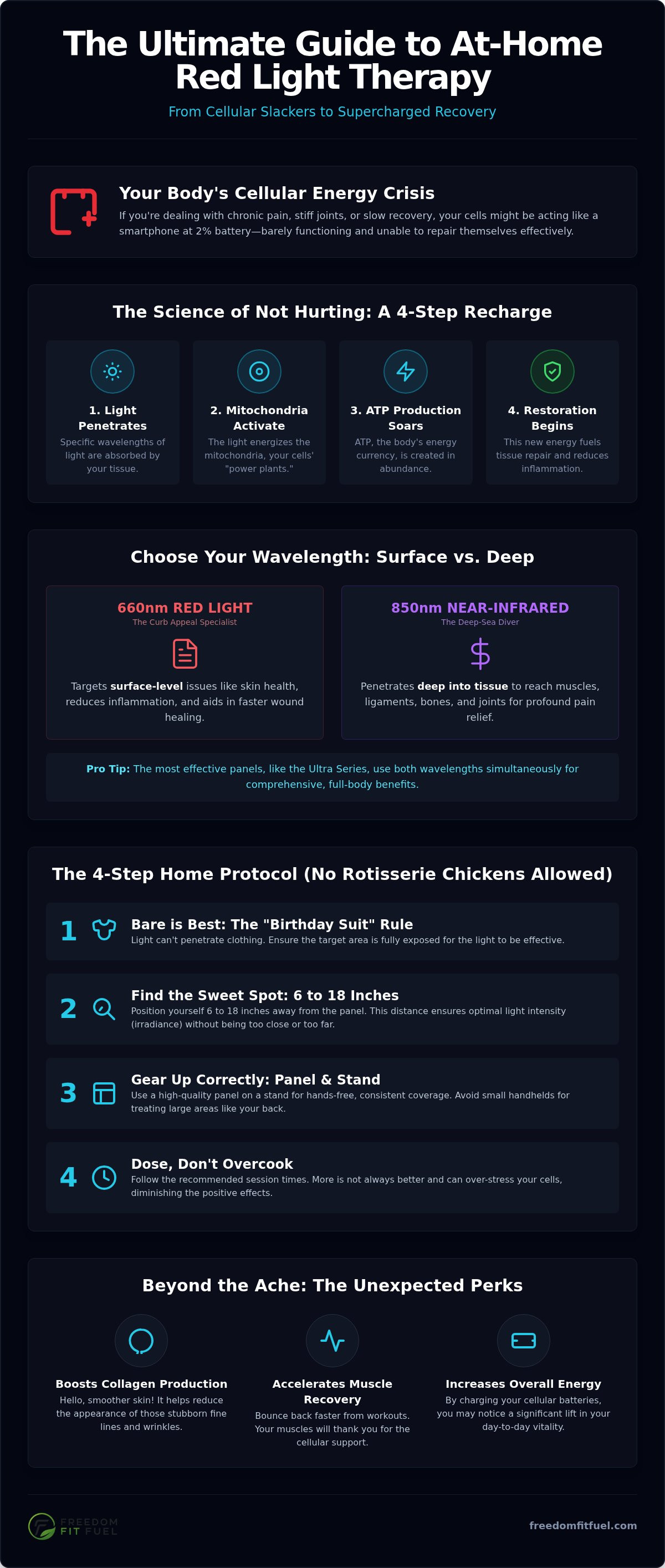
- Master the "Birthday Suit" rule and the 6 to 18-inch distance sweet spot for effective red light therapy for pain relief at home.
- Learn why a panel with a stand is a non-negotiable tool for hands-free healing, because nobody should get a cramped arm while trying to fix a sore back.
- Discover how to leverage collagen production to silence joint stiffness while accidentally smoothing out those stubborn wrinkles.
- Find out how to design a dedicated recovery sanctuary that turns your daily restoration protocol into a calming, repeatable ritual.
The Science of Not Hurting: How Red Light Actually Works (No, It’s Not Magic)
Let's talk about photobiomodulation. It sounds like something a sci-fi villain would use to power a doomsday device, but it's actually the scientific foundation of The Science of Red Light Therapy. Essentially, it means using light to nudge your cells into actually doing their jobs. Right now, your achy lower back or stiff knees are likely suffering from a cellular energy crisis. Think of your cells like a smartphone at 2% battery; they're barely functioning, the screen is dim, and the apps keep crashing. When you apply red light, you're essentially plugging that phone into a high-speed charger.
The magic happens in the mitochondria, those tiny power plants inside your cells that high school biology promised you'd never need to think about again. When these power plants are sluggish, your body struggles to manage inflammation or repair tissue. This leads to that familiar, lingering ache that refuses to leave. Using red light therapy for pain relief at home provides the specific light frequencies needed to jumpstart these engines, moving your body from a state of "just getting by" to active restoration.
ATP and Your Cellular Power Plant
Inside your cells, photons trigger the release of nitric oxide, which often gets stuck and clogs up the works like a bad traffic jam. Once light kicks it out, oxygen flows freely and ATP production skyrockets. Think of ATP as a cellular stimulus check. It's the currency your body uses to repair tissue, dampen inflammation, and finally fix that mystery back pain that's been nagging you for months. Increased ATP means your cells finally have the "cash" on hand to invest in deep, structural repairs rather than just putting a temporary bandage on the problem.
Wavelengths: Why Your Eyes See Red but Your Joints Need Infrared
Not all light is created equal. If you're looking to soothe surface-level drama like skin inflammation, 660nm visible red light is your best friend. It stays near the surface, tidying up the "curb appeal" of your biology. However, if the pain is deeper, such as in your tendons or ligaments, you need 850nm near-infrared light. This wavelength is a deep-sea diver; it penetrates much further into the body to reach the source of the ache. The Ultra Series Red & Near-Infrared LED Therapy Panel uses both wavelengths simultaneously because your body usually has both surface and deep-tissue issues to resolve at once.
Just remember that more is not always better. You might be tempted to park yourself in front of the panel for hours, but biology follows a specific dose response. Too much light can actually stress the cells out, leading to what we call the "rotisserie chicken effect." You want to be restored, not overcooked. Stick to the recommended times to ensure your recovery remains a calming, effective ritual rather than a counterproductive chore.
Choosing Your Photon Cannon: Panels, Stands, and Wavelengths
You've decided to stop grunting every time you get off the couch. Great. Now comes the part where you actually have to buy the gear. If you browse any major online retailer, you'll see thousands of plastic handheld gadgets that look like oversized TV remotes. Here is the truth: trying to treat your lower back with a handheld device is a fast track to a secondary injury. You'll end up with a cramped arm and a sore neck from trying to reach behind yourself like a contorted gymnast. To get real results with red light therapy for pain relief at home, you need a panel that does the heavy lifting for you.
Professional-grade panels offer the power and coverage that small devices lack. When researching how red light therapy works, you'll find that irradiance is key. This is the intensity of the light. If the light is too weak, your cells won't get enough energy to trigger repair. You also need to watch out for flicker and high EMF levels. Cheap LEDs often pulse at a frequency that can cause headaches or eye strain. You shouldn't trade your joint pain for a neurological protest. High-quality equipment ensures you're bathing in healing light, not electromagnetic chaos.
The Anatomy of a Professional-Grade Panel
A quality panel isn't just a box of bright lights. It's an intentional piece of recovery equipment. The Ultra Series Red & Near-Infrared LED Therapy Panel is built with professional-grade LEDs that provide consistent, targeted wavelengths. But the real secret weapon is a sturdy stand. Having a led therapy panel with stand for wrinkle reduction and pain allows you to position the light exactly where it’s needed without playing a game of Twister. Whether you’re targeting your lumbar spine or your face, hands-free operation is the difference between a chore and a ritual. It allows you to focus on the sensation of restoration rather than the logistics of holding a device.
Full Body vs. Targeted Panels
Do you need to bathe your entire body in photons or just fix a cranky knee? If you have systemic inflammation or want a full-body metabolic boost, a larger panel is a worthy investment. However, a targeted panel is often enough for specific joint issues. The key is positioning. You want to create a recovery corner where you can relax, perhaps near your favorite chair. It's about making restoration easy. If your setup is a hassle, you won't use it. You can explore the Ultra Series collection to find the right fit for your personal sanctuary.
The Ultimate Home Protocol: How to Use Your Panel Without Looking Like a Rotisserie Chicken
Owning a high-end panel is a fantastic first step, but using it correctly is what separates the "this changed my life" crowd from the "I think it's just a red lamp" skeptics. To get the most out of red light therapy for pain relief at home, you need to follow a protocol that respects your biology. First, you must embrace the Birthday Suit Rule. Photons are powerful, but they aren't ghosts; they cannot travel through your favorite denim jacket or even a thin cotton t-shirt. For cellular restoration to happen, the light must hit your skin directly and without interference.
Distance is your next variable. You want to be close enough to receive the necessary intensity but far enough to cover the target area. Usually, a distance between 6 and 18 inches is the sweet spot. If you're too far away, you're just enjoying a nice glow without the therapeutic benefits. Aim for a window of 10 to 20 minutes per session. Your cells have a biological "fill line" for light energy. Once you hit that limit, staying longer won't provide extra benefits; it just wastes your evening. It's about being steady, methodical, and intentional.
Finally, remember that consistency beats intensity every single time. You cannot binge-watch your way to physical recovery. A 15-minute daily ritual is far more effective for silencing chronic aches than a two-hour light marathon once a week. Your body needs regular, predictable signals to stay in a state of active repair and renewal.
Targeting Specific Pain Points
When dealing with the lower back, use your stand to position the Ultra Series panel at lumbar level while you relax in a chair. For knees or shoulders, try different angles to ensure the light reaches the joint from multiple sides. If you have just finished a heavy session with your weights or pilates reformer, a quick 10-minute blast can significantly reduce that "I can't walk down stairs" feeling the next morning. This targeted approach ensures the energy goes exactly where the drama is happening.
Safety and Eye Protection
While red light is a "cold" therapy and won't actually grill you, your eyes are quite sensitive to the brightness. Don't stare directly into the LEDs. You can simply close your eyes or use the provided goggles to keep things comfortable. It is also wise to perform a quick skin sensitivity check for a few minutes during your first session. Most people find the experience to be soothing, warming, and deeply restorative, but it's always better to be the person who checked rather than the person who guessed.
Beyond the Ache: Wrinkles, Recovery, and Why Your Cells Are Lazy
While you might have started exploring red light therapy for pain relief at home to fix a cranky lower back, you're about to discover a side effect that most people actually want. It's the biological equivalent of buying a reliable SUV and discovering it also has a built-in espresso machine. As those photons penetrate your tissue to quiet your nerves, they also stimulate the fibroblasts responsible for collagen. Collagen is the biological scaffolding that keeps your skin firm and your joints supple; it's essentially the glue holding your dignity together as you age.
We often talk about "lazy cells" because chronic inflammation acts like a heavy blanket that smothers cellular ambition. When your body is stuck in a cycle of pain, your cells stop trying to repair and start merely surviving. Red light therapy acts like a supportive, yet firm, wake-up call. It "shouts" at your mitochondria to get back to work. Looking five years younger is simply a pleasant bonus for your hardworking muscles and joints. It’s a nice way for your body to say thanks for finally giving it the energy it needs to thrive.
The Wrinkle Reduction Protocol
If you have a stand-mounted panel, you don't need to change much to benefit your skin. A quick five-minute facial "recharge" from about 12 inches away can do wonders. Collagen synthesis is the primary mechanism for maintaining skin elasticity and reducing the appearance of fine lines. You can easily integrate this into your existing skincare routine. Just ensure your face is clean and free of heavy sunscreens or opaque creams that might block the light. It's an effortless way to cultivate a glow while you're already busy silencing your joint stiffness.
Stacking for Success: PEMF and Red Light
To reach the peak of home restoration, you should consider the synergy of stacking different modalities. While red light provides the photons your cells need for energy, Pulsed Electromagnetic Field (PEMF) therapy provides the magnetic "recharge" that improves cellular voltage. It’s the difference between giving a worker a better tool and giving them a full night’s sleep. Combining these magnetic fields with photons creates a powerhouse environment for deep tissue healing. You can learn more about how this works in our guide on the PEMF Mat for Pain Relief: Why Your Cells Need a Recharge. When you use these tools together, you aren't just managing symptoms; you're building a sanctuary of renewal. You can explore our Ultra Series panels and PEMF mats to start your own restoration ritual today.
Designing Your Sanctuary: Integrating Red Light into a Life of Restoration
Your environment is the silent architect of your daily habits. If your equipment is buried in a closet behind a stack of old magazines, it won't be used. To truly master red light therapy for pain relief at home, you must create a dedicated recovery corner that feels intentional, restorative, and calming. The point isn’t finding a plug. It’s designing a space that signals to your brain that the "chaos" of the day is officially over. Unless your goal is to own the world’s most expensive red-tinted doorstop, you need a plan for consistency.
The evening wind-down is the perfect time for this ritual. As you bask in the warm glow of your panel, you're doing more than just soothing physical aches. You're providing a biological signal that it's time to shift from "fight or flight" mode into "rest and digest." For the serious biohacker, the ultimate protocol involves stacking your light therapy with a heat session. Using an Ultra Series panel alongside a sauna creates a powerful synergy of light and heat that helps you soothe, repair, and recharge your entire system simultaneously.
The Mindful Home Gym
Positioning is everything. If you already have a space for movement, place your panel near your Pilates reformer or weight rack. This allows for immediate post-set recovery while your blood flow is still peaked. You can turn a grueling workout into a luxury experience by ending with a session that feels like a reward rather than a chore. If you want to take this sanctuary to the next level, our Guide to 2-Person Low EMF FAR Infrared Saunas explores how to integrate deep heat into your home recovery suite. It’s about building a toolkit that supports your evolution toward a more balanced life.
Your Journey to Freedom
Taking control of your physical well-being is a profound act of self-care. Chronic pain often feels like a thief, but natural, light-based restoration offers a way to reclaim your mobility and confidence. Freedom Fit Fuel is here to act as your partner in this intentional journey. We provide the professional-grade tools you need to stop merely managing symptoms and start thriving. For more on the technical side of your new ritual, check out The Bright Side of Biohacking: A Guide to Red Light Therapy Panels for Home Use. Investing in an Ultra Series panel is an investment in your future, less-achy self. It is time to step into the light and leave the groaning behind.
Step Into Your Brightest Future
You now have the blueprint for turning your body's cellular power plants back on. By understanding that red light therapy for pain relief at home is a biological recharge rather than a magic trick, you're already ahead of the skeptics. Success lies in the simple details: stripping down to your birthday suit, maintaining that 6 to 18-inch sweet spot, and showing up for yourself every single day. Whether you're silencing a cranky lower back or accidentally smoothing out a few wrinkles, you're choosing a path of intentionality and restoration.
Your home should be a sanctuary where recovery feels like a premium experience rather than a clinical chore. Freedom Fit Fuel provides the professional-grade recovery gear and curated support you need to make this evolution possible. With national shipping for your home wellness sanctuary, the tools for a more balanced life are within reach. It’s time to stop negotiating with your aches and start investing in the vibrant, mobile version of yourself that’s waiting just beneath the surface.
Explore the Ultra Series Red Light Panels at Freedom Fit Fuel and begin your journey toward lasting renewal today. You've got this.
Frequently Asked Questions
How long does it take for red light therapy to work for pain?
Acute relief can often be felt within 15 minutes of your first session, but structural changes for chronic issues typically require 3 to 4 weeks of consistent use. You are essentially retraining your cells to function at a higher level. This isn't a temporary bandage; it's a methodical, steady, and intentional process of physical renewal that rewards patience and daily commitment.
Can I use red light therapy every day at home?
Daily use is actually the gold standard for red light therapy for pain relief at home. Consistency signals your cells to stay in a state of active restoration rather than slipping back into survival mode. Most protocols suggest 10 to 20 minutes daily for optimal results. Skipping days is essentially like pausing a software update; it just delays the version of yourself that feels better.
Does red light therapy penetrate through clothes?
Photons are not ghosts; they cannot pass through your favorite gym leggings or a cotton t-shirt. For cellular restoration to happen, the light must hit your skin directly without any barriers. If you stay dressed, you're essentially just paying for a very bright, very red mood light. For real results, embrace the birthday suit rule and let the light do its work.
Is red light therapy safe for my eyes?
It is generally safe, but the brightness can be intense and uncomfortable. You should avoid staring directly into the LEDs for long periods. Closing your eyes or using the provided blackout goggles ensures your session remains a calming, soothing, and restorative experience. If you have pre-existing eye conditions, checking with a medical professional is always a wise, intentional move.
What is the difference between red light and infrared light?
The primary difference is the depth of penetration. Red light (660nm) focuses on the surface, tidying up skin health and minor inflammation. Near-infrared light (850nm) is invisible to the eye and dives deep into joints, tendons, and muscles. Using a panel that offers both ensures you're treating the source of the pain and the surface-level symptoms simultaneously for a complete recovery.
Can I overdo red light therapy?
Your cells have a biological "fill line" for light energy. Once you hit that saturation point, staying in front of the panel won't provide extra benefits and might actually trigger a minor stress response in the tissue. It's like charging a battery; once it's at 100%, leaving it plugged in doesn't make it more powerful. Stick to the recommended 20-minute limit for safe restoration.
Do I need a special stand for my red light therapy panel?
You don't strictly need one, but unless you enjoy playing a high-stakes game of Jenga with your expensive recovery gear, a stand is highly recommended. It allows you to position the panel with precision, intentionality, and ease. A stand turns a clunky setup into a repeatable ritual, ensuring you can target your lower back or knees without needing a third arm to hold the device.
Can red light therapy help with both chronic pain and wrinkles simultaneously?
Yes, and it is perhaps the most pleasant side effect in the history of wellness. The same near-infrared waves that dive deep into your joints are accompanied by red light that stimulates collagen production at the surface. You can silence your chronic lower back pain and smooth out fine lines in the same 15-minute window. Using red light therapy for pain relief at home is the ultimate way to soothe, restore, and renew.