

Red Light Therapy for Muscle Recovery: Because Your Muscles Deserve Better Than a Bag of Frozen Peas
If your current post-workout ritual involves shivering under a bag of frozen peas while questioning every life choice that led to that final set of squats, it's time to admit your muscles deserve a promotion. We've all been there; hobbling down the stairs like a newborn giraffe because Delayed Onset Muscle Soreness (DOMS) decided to move in for the week. While the fitness industry loves to sell you neon-colored powders and "miracle" supplements that mostly just result in expensive urine, the real breakthrough in 2026 is actually much brighter. Using red light therapy for muscle recovery isn't just a trend for elite athletes; it’s a well-studied way to talk directly to your cells, encouraging them to repair, renew, and recharge without the frostbite.
You're likely tired of recovery rituals that eat up your entire evening or gadgets that simply don't deliver on their promises. It's frustrating to feel like your progress is stalled by a body that refuses to keep up with your ambition. We're going to show you how to slash those recovery times and optimize your cellular health using the power of full-body panels. We'll get into the mitochondrial science behind the glow, explore why the Ultra Series is the missing link in your home gym, and help you reclaim your time so you can get back to the movement you love.
Key Takeaways
- Discover why passive icing is a relic of the nineties and how to upgrade your recovery ritual to match your modern training intensity.
- Explore how red light therapy for muscle recovery triggers an ATP explosion in your mitochondria to accelerate tissue repair and reduce inflammation.
- Identify the critical differences between targeted "flashlight" devices and professional-grade full-body panels for a more efficient, systemic recovery process.
- Learn the specific "Goldilocks Zone" protocols for timing and distance to maximize the restorative power of the Ultra Series in your home sanctuary.
- Stop wasting your limited time on recovery rituals that don't work and start using science to slash your downtime between training sessions.
Why Your Post-Workout Recovery Routine is Probably Stuck in the Stone Age
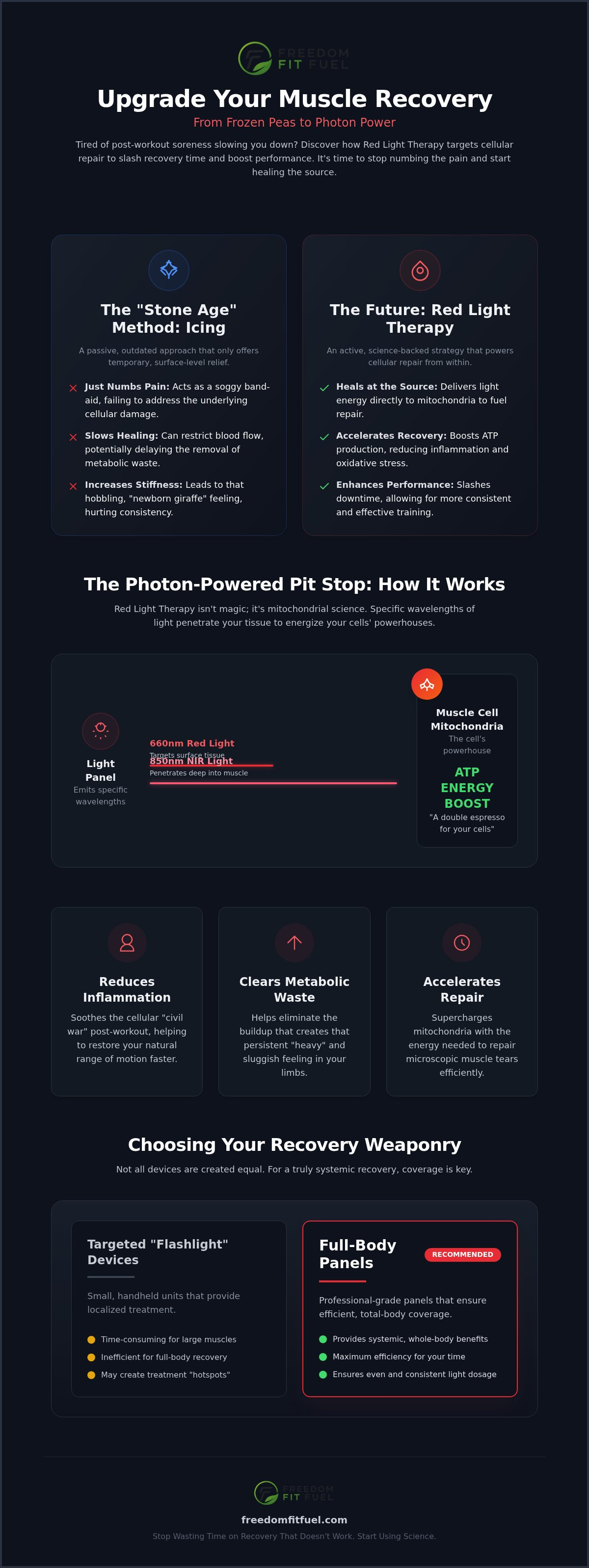
Let's address the frozen peas in the room. It’s a tragedy, really. You’ve just crushed a high-intensity session, your endorphins are humming, and then you spend twenty minutes balancing a bag of icy legumes on your quads. It’s 2026, yet many recovery routines are still stuck in 1995. Passive icing might numb the surface, but it’s essentially a cold, soggy band-aid for a much deeper physiological crisis. When we talk about DOMS, we aren’t just describing "tired" legs; your muscle fibers are currently hosting a microscopic civil war. This cellular conflict manifests in three distinct ways:
- Acute inflammation that limits your natural range of motion.
- Metabolic waste buildup that creates that persistent "heavy" feeling in your limbs.
- Microscopic structural damage that requires immediate cellular energy to repair.
To better understand the science of how your body actually repairs itself and how red light therapy for muscle recovery fits into the puzzle, watch this helpful video:
The Cost of Slow Recovery
Ignoring this internal chaos doesn't make you a hero. In fact, the old-school mentality of "pushing through the pain" is usually just an express ticket to an expensive consultation with a physical therapist. The real cost of a sluggish recovery is the slow erosion of your consistency. It’s nearly impossible to stay devoted to your Freedom Journey when you’re too stiff to tie your own shoes or reach for a coffee mug. Professional athletes stopped relying on "sleep and prayer" a decade ago because they realized that waiting for the body to fix itself is a passive, inefficient strategy. They moved toward active restoration to maintain their edge, and now that same technology is available for your own home sanctuary.
Enter Photobiomodulation (PBM)
This is where the light comes in. Photobiomodulation, often referred to as Low-level laser therapy, is the sophisticated term for using specific light wavelengths to trigger cellular repair. Unlike the aggressive UV rays that provide a tan and a side of sun damage, red and near-infrared light operate on a healing frequency. This isn't about generating heat; it's about delivering pure energy to the source of the struggle. By utilizing red light therapy for muscle recovery, you are essentially giving your cells the blueprints they need to build, strengthen, and thrive. It’s the intentional, "Ultra" way to ensure your downtime is just as productive as your uptime.
The Photon-Powered Pit Stop: How Red Light Heals Your Cells
Think of your muscle fibers as tiny, frantic offices staffed by mitochondria. These are the overworked interns responsible for keeping the repairs moving and the energy flowing. After a heavy session, they're usually drowning in metabolic paperwork and cellular debris. Red Light Therapy is a non-invasive process that uses specific light wavelengths to stimulate mitochondrial ATP production and reduce oxidative stress. It’s essentially a double espresso for your cells, providing the immediate energy needed to repair damage fast.
The magic happens through a specific power duo: 660nm red light and 850nm near-infrared (NIR) light. Forbes Health explains red light therapy benefits as a way to enhance athletic performance and speed up tissue repair. While the red light handles the surface, the NIR light dives deep into the muscle belly to do the heavy lifting. This combination is why red light therapy for muscle recovery has become a staple for anyone serious about their physical evolution in 2026.
Reducing the Fire: Inflammation and Oxidative Stress
NIR light doesn't just sit on the skin; it penetrates deep into the muscle tissue where the real damage lives. It initiates the "Nitric Oxide shuffle," which helps release nitric oxide to clear out metabolic junk so fresh, oxygenated blood can actually flow. This is a far more intentional approach than popping anti-inflammatory pills. Those pills might dull the ache, but they can actually hinder long-term muscle growth by blunting the body's natural adaptation response. Using red light therapy for muscle recovery allows you to soothe the fire without sabotaging your gains.
Collagen and Repair: More Than Just Skin Deep
Your biceps get all the glory, but your tendons and ligaments are the unsung heroes of every heavy lift. These connective tissues are notoriously slow to heal because they have less blood flow than muscle. Light therapy stimulates collagen production, which is essential for structural integrity and long-term resilience. If you're building a wellness sanctuary at home, understanding The Bright Side of Biohacking is the first step toward a more balanced body. As you curate your personal space, choosing tools with professional-grade wavelengths is essential for your Freedom Journey.
Full-Body Panels vs. Targeted Devices: Choosing Your Recovery Weaponry
Choosing the right gear for your restoration journey is a bit like picking a vehicle; you can either get a reliable sedan or a high-performance engine that actually gets you where you’re going. Many people start with small, handheld devices, only to realize they've accidentally signed up for a part-time job. We call this the "Flashlight problem." Spending forty minutes manually waving a tiny wand over your hamstrings isn't just a recipe for boredom; it’s an inefficient way to manage red light therapy for muscle recovery. If your goal is restoration, you shouldn't have to work that hard to get it.
Full-body panels, like the Ultra Series, offer a "set it and forget it" approach that transforms recovery from a chore into a ritual. Instead of treating one square inch at a time, you’re bathing your entire system in restorative wavelengths. This systemic approach is often more cost-effective than frequent clinic visits. While a single session at a boutique wellness center might feel premium, owning your own panel means you have professional-grade technology available every single morning of 2026. Plus, you won't have to worry about high EMF (electromagnetic field) levels. Low EMF isn't just a buzzword; it’s about ensuring your "healing" session doesn't involve marinating your cells in unnecessary radiation.
When to Go Full-Body
If you’re a regular at the squat rack or someone who hits multiple muscle groups in a single session, full-body exposure is the gold standard. There’s a significant hormonal benefit to systemic light exposure that localized treatments simply can't match. By treating the whole body, you're encouraging a more comprehensive reduction in oxidative stress. It’s the perfect companion to other high-end tools, such as a PEMF Mat for Pain Relief, creating a multi-layered sanctuary for your physical evolution. This setup allows you to address systemic inflammation while you simply breathe and recharge.
Targeted Panels for Specific Weak Points
Sometimes you have that one "problem knee" that remembers every injury from high school, or a lower back that deeply resents your desk chair. Targeted panels allow you to deliver a concentrated dose of light to these specific areas without the bulk of a full-body setup. They’re excellent for portability, allowing you to take your red light therapy for muscle recovery on the road. Many discerning athletes choose to mix and match, using a full-body panel for general vitality and a smaller unit for localized maintenance. This curated approach ensures every part of your body receives the intentional care it needs to thrive.
The Professional’s Protocol: Mastering Your At-Home Red Light Ritual
Mastering your red light therapy for muscle recovery isn't rocket science, but it does require more intentionality than just standing near a red glow and hoping for the best. If you want to move from a casual user to a recovery professional in 2026, you need to respect the simple physics of light. It’s about more than just the equipment; it’s about the ritual you build around it.
Finding the "Goldilocks Zone" with your Ultra Series panel is your first priority. Aim to stand between 6 and 12 inches from the LEDs for deep muscle work. If you’re too close, you lose the even coverage across your limbs; if you’re too far, the photons lose the energy density required to reach those deeper tissues. Duration is equally critical. The sweet spot is 10 to 20 minutes per area. Standing in front of the panel for two hours won't make you recover ten times faster; it just makes you a person who wasted half their evening and a decent amount of electricity.
The Pre-Workout Primer
Using light before you hit the weights acts as a cellular "wake up" call. It primes your mitochondria and encourages local blood flow, ensuring your muscles are ready for the stress you’re about to impose. Think of it as a biological head start. Pairing this 10-minute session with a light mobility flow creates a powerful, intentional transition into your workout. It’s a proactive way to reduce the risk of injury by ensuring your cellular engines are warm before the first set begins.
The Post-Workout Restoration
The 24-hour window following your training is when the real battle against inflammation occurs. This is the optimal time for red light therapy for muscle recovery to shine. To maximize the impact, many discerning athletes stack their light ritual with other restorative practices like cold plunges. This contrast approach helps flush out metabolic waste while the light provides the energy for structural repair.
Consistency is the only "secret" in the world of biohacking that actually delivers results. One session won't undo a week of overtraining, but a daily habit builds a foundation of systemic resilience. While you’re under the glow, do yourself a favor and ditch the smartphone. Scrolling through emails while your body is trying to heal is a distraction your nervous system doesn't need. Embrace the quiet, focus on your breath, and let the restoration take place.
Ready to elevate your recovery game? You can find the professional-grade Ultra Series Red & Near-Infrared LED Therapy Panel and start building your own sanctuary today.
Elevating Your Sanctuary with Ultra Series LED Therapy
You’ve already done the hard work. You’ve assembled the weights, mastered the squat rack, and perhaps even dedicated a corner to your Pilates reformer. Your home gym is a testament to your ambition; however, a gym without a recovery plan is just a room where you get tired. The Ultra Series Red & Near-Infrared LED Therapy Panel is the final, elegant piece of the puzzle. It’s the missing link that transforms a high-intensity workout space into a holistic wellness sanctuary. By integrating red light therapy for muscle recovery into your daily environment, you’re acknowledging that your body’s downtime is just as vital as its uptime.
The Ultra Series isn't just a piece of technology; it’s a marriage of professional-grade power and sophisticated home design. We’ve moved past the era where effective recovery tools had to look like they belonged in a sterile hospital basement. In 2026, your restoration ritual should feel as premium as the results it produces. You’ve put in the effort under the iron; now, it’s time to let the light do the rest of the heavy lifting for your cellular health. It is a quiet, powerful way to honor the effort you put in every single day.
The Freedom Fit Fuel Difference
At Freedom Fit Fuel, we don't just sell products; we curate experiences that respect your biology. We focus on high-quality, low EMF technology because we believe your healing space should be free from unnecessary environmental stressors. Our mission is to provide supportive guidance for your long-term evolution, acting as a partner rather than just a vendor. You can learn more about our philosophy and the people behind the brand by visiting our page About Freedom Fit Fuel. We’re here to ensure your "Freedom Journey" is built on a foundation of trust, quality, and intentionality.
Your Next Step Toward Restoration
Red light is arguably the ultimate "low effort, high reward" recovery tool in your arsenal. It requires nothing more from you than fifteen minutes of standing still and breathing. Let’s be honest: you can’t out-train a lack of recovery. You can buy all the supplements in the world, but if your cells are starving for energy, your progress will eventually hit a wall. It’s time to give the frozen peas a dignified retirement and step into the glow of professional restoration. Explore the Ultra Series Red & Near-Infrared LED Therapy Panel today and finally give your muscles the sophisticated care they’ve been asking for.
Reclaiming Your Recovery Ritual
Your muscles have endured enough. Between the "Stone Age" ice packs and the neon-colored supplements that offer more hype than help, it’s time to choose a more intentional path. We’ve explored how red light therapy for muscle recovery works at a cellular level, turning those overworked mitochondria into efficient repair machines. By choosing professional-grade technology, you aren't just buying a gadget; you’re investing in a sanctuary that respects your biology and your limited time. You’ve put in the work at the squat rack; now, give your body the sophisticated tools it needs to actually keep up with your ambition.
The Ultra Series offers wavelengths optimized for deep muscle penetration and low EMF technology to ensure your healing space remains a true refuge. It’s the ultimate low-effort, high-reward addition to your home gym. Stop waiting for the soreness to fade on its own and start taking control of your restoration journey. Explore the Ultra Series Red & Near-Infrared LED Therapy Panels and see how a little photon-powered rest can transform your training. You’ve earned the progress; let the light help you protect it.
Frequently Asked Questions
How long does it take for red light therapy to help muscle recovery?
You can expect to feel a reduction in soreness within 24 hours of your first session. While acute DOMS relief is often immediate, the cumulative benefits for cellular health take about two to four weeks of consistent use. Think of it as biological compound interest; the more you invest in your red light therapy for muscle recovery sessions, the faster your body learns to repair itself.
Can I use red light therapy every day after working out?
Yes, daily use is perfectly safe and actually encouraged for the best results. Most athletes find that a 10 to 20 minute session after their training helps maintain a steady state of cellular energy. You don't need to worry about overdoing it as long as you stick to the recommended timing. Using it every day ensures your mitochondria never run out of the fuel they need for constant tissue maintenance.
Should I use red light therapy before or after exercise?
Both have unique benefits, so the choice depends on your specific goal for the day. Use it before exercise to "wake up" your muscles and increase blood flow for better performance. Use it after your session to switch your body into repair mode and flush out metabolic waste. If you have to choose just one, post-workout is the gold standard for reducing inflammation and the dreaded leg-day hobble.
Do I need to wear eye protection with full-body red light panels?
You should wear the provided goggles if you are looking directly at the LEDs or if you find the brightness uncomfortable. While red light is generally safe, the high intensity of professional panels can be quite dazzling. It’s better to protect your vision while your muscles soak up the benefits. Close your eyes and use the time for a quick mindfulness break; your retinas will thank you for the extra care.
What is the difference between red light and near-infrared light for muscles?
Red light (660nm) targets the surface layers of your skin, while near-infrared (850nm) penetrates deep into the muscle tissue and joints. The Ultra Series uses both because your body isn't one-dimensional. Red light helps with surface inflammation and skin health, but near-infrared is the real workhorse for red light therapy for muscle recovery. It reaches the deep fibers where micro-tears actually happen after a heavy lifting session.
Is there anyone who should not use red light therapy for recovery?
People with active skin cancers, light sensitivity disorders, or those who are pregnant should consult a medical professional first. While the technology is non-invasive and low-risk, your specific biology might have different needs. If you have a fever or an acute infection, it’s also wise to wait until you’ve cleared the bug. Always prioritize your safety over a faster recovery time; your panel will be waiting for you when you’re ready.
Can red light therapy help with old sports injuries or just new soreness?
It helps with both by stimulating blood flow and collagen production in damaged areas. For new soreness, it acts as a fast-acting anti-inflammatory. For old sports injuries, it encourages the remodeling of scar tissue and provides the energy needed for long-dormant repair processes to kick back into gear. It won't give you a bionic knee, but it can certainly make your current one feel a lot less like a rusty hinge.
Do I need to be naked for red light therapy to work on my muscles?
Light needs direct contact with your skin to work its magic, so less clothing is definitely better. Heavy fabrics like denim or thick cotton will block the photons entirely, rendering your session useless. You don't need to be completely naked, but the target muscle group must be exposed. Think of it as a private beach day in your own home sanctuary; just you, the glow, and a significantly faster path to your next personal record.