

The Mindful Buyer’s Guide to the Pilates Reformer: Elevating Your Home Sanctuary
Your living room should be a sanctuary, not a graveyard for clunky, squeaking plastic that sounds like a haunted house every time you try to find your obliques. You've likely felt the frustration of staring at equipment that looks more like a medieval torture device than a tool for restoration. You want the precision of a boutique studio session without the $45 drop-in fee or the communal smell of a public gym. Choosing the right Pilates Reformer shouldn't feel like a high-stakes gamble on your floorboards and your sanity.
We agree that your home deserves better than unstable carriages and confusing mechanics. You're looking for a machine that offers professional-grade performance, sleek aesthetics, and whisper-quiet movement. This guide promises to help you find that perfect balance, ensuring your equipment fits your space and your lifestyle. We'll explore how to evaluate spring tension, maximize limited square footage, and curate a dedicated space for intentional growth. Let's transform your home into a place of balance, strength, and genuine recharge.
Key Takeaways
- Understand why the eccentric loading of a spring-based system offers the deep core-strengthening results your yoga mat simply can't replicate.
- Identify the essential mechanical features that ensure a silent, smooth, and stable glide for a truly professional experience that won't wake the neighbors.
- Determine whether a heavy-duty studio-grade Pilates Reformer or a space-saving folding model best aligns with your home’s layout and your fitness goals.
- Master the mindful buyer’s checklist to prioritize comfort features like adjustable headrests and padded platforms that keep you focused on movement rather than joint pain.
- Discover how to pair active movement with passive recovery tools to build a balanced, restorative, and intentional home sanctuary that promotes long-term wellness.
The Pilates Reformer: More Than Just a Fancy Sliding Bench
Let’s be honest. At first glance, a Pilates Reformer looks like an elaborate piece of furniture designed for people who enjoy being stretched like taffy. It’s easy to dismiss it as a glorified bench, but it’s actually a sophisticated system of springs, pulleys, and a sliding carriage designed for eccentric muscle loading. This is just a fancy way of saying your muscles are working while they lengthen. It’s the secret sauce for building strength without the bulk, providing a level of resistance that your living room floor simply can’t offer.
The beauty of this machine lies in its adherence to the Pilates method and its six core principles: centering, concentration, control, precision, breath, and flow. Your hardware isn't just a rack for your gym clothes; it’s the physical manifestation of these ideas. When you’re on the carriage, the springs demand your absolute focus. If you lose control, the machine tells you immediately with a clunk or a jerk. It’s a brutally honest coach that doesn’t charge by the hour.
Mat vs. Reformer: The Great Debate
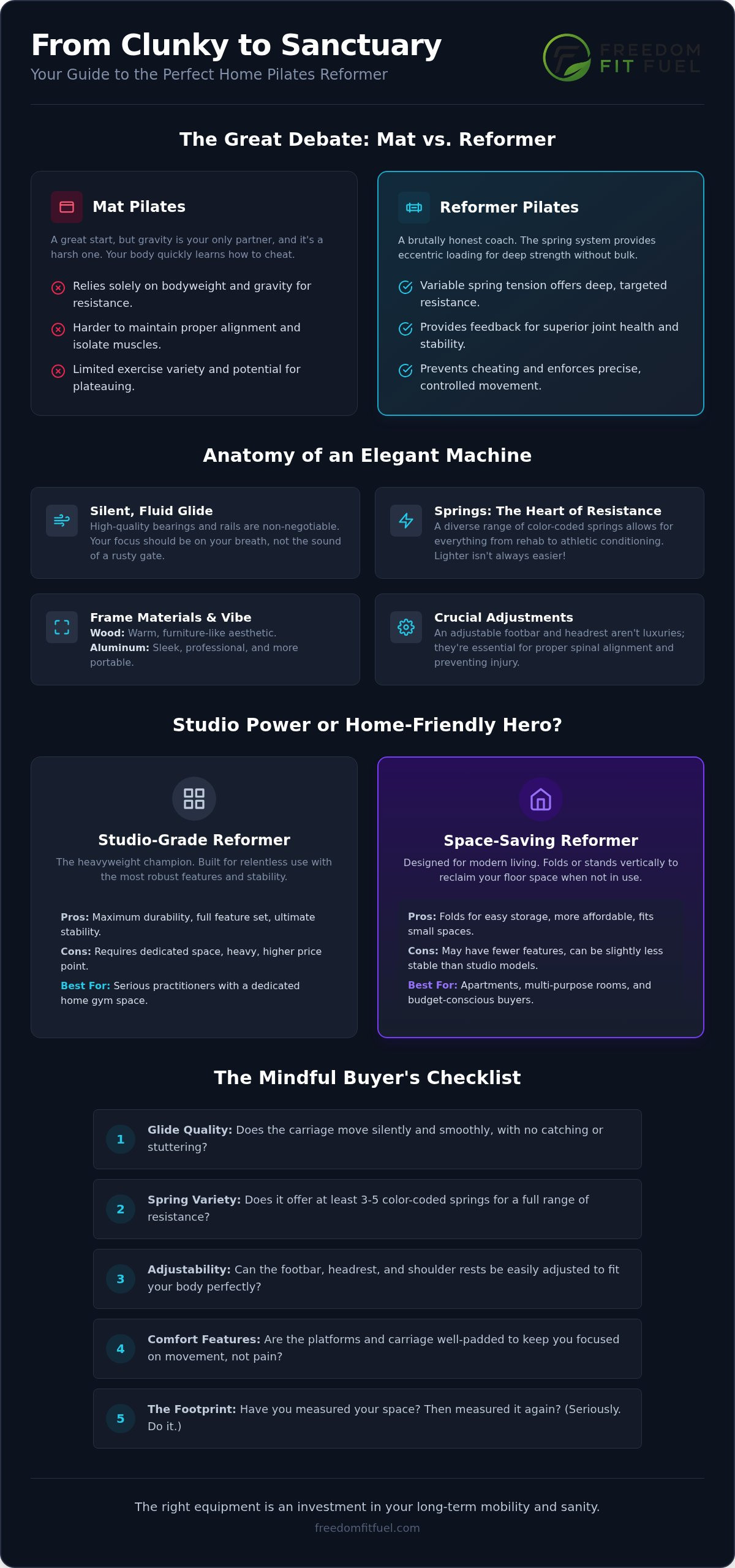
Mat Pilates is a fantastic starting point, but gravity is a harsh mistress. On a mat, you’re either fighting the earth or your own lack of flexibility. The Pilates Reformer changes the game by introducing variable spring tension. This allows for closed-chain exercises, where your hands or feet are fixed against a footbar or in straps. This setup provides incredible feedback for joint health and stability. It makes it much easier to maintain proper alignment than when you're flailing around on a foam pad. If your floor-based core routine has plateaued, it’s likely because your body has figured out how to cheat. The reformer doesn't allow for such nonsense.
The Investment in Longevity
We need to talk about the "friction" of fitness. Driving to a studio, finding parking, and paying for a single drop-in class is a lot of effort. Eventually, the couch wins. Owning professional-grade gear at home removes those excuses. It’s an investment in your long-term mobility that pays dividends every time you skip the commute. We like to think of the reformer as the "active" partner to your "passive" recovery tools. Placing your machine near an infrared sauna creates a "Restoration Ritual." You move with intention on the reformer, then melt into the heat of the sauna to recover. It’s not just a workout; it’s a curated lifestyle shift that prioritizes your evolution over mere sweat.
Anatomy of an Elegant Machine: Springs, Straps, and Sanity
The soul of a Pilates Reformer lives in its movement. If the carriage catches, stutters, or sounds like a rusty gate, your mindful movement practice will quickly devolve into a meditation on mechanical failure. A high-quality machine uses precision bearings and high-grade rails to ensure a silent, fluid glide. This silence is essential; it allows you to hear your own breath rather than the protest of cheap plastic wheels. You're building a sanctuary, not a machine shop.
Beyond the glide, the footbar and straps provide the anchor for your practice. An adjustable footbar isn't just a luxury; it’s a necessity for maintaining proper spinal alignment across different heights and exercises. Similarly, the ropes and pulleys should be no-noise versions. There is nothing quite as jarring as a rhythmic squeak during a set of leg circles to ruin your flow. Your equipment should be seen and felt, but rarely heard.
Springs: The Heart of the Machine
In the world of Pilates, heavy is not a synonym for better. Springs are typically color-coded to indicate resistance levels, ranging from light to heavy. Working with a lighter spring often requires more core stabilization, making the exercise significantly more difficult than grinding through heavy resistance. You want a machine that offers a diverse range of spring weights to accommodate everything from rehabilitative work to advanced athletic conditioning. Progressive resistance refers to the way spring tension increases proportionally as the carriage moves further from the footbar, challenging your muscles through the entire range of motion. High-quality springs also ensure safety; nobody wants a metal coil to snap while they're mid-Teaser.
Frame Materials: Wood vs. Aluminum
Your choice of frame material often dictates the vibe of your home sanctuary. Solid wood frames, typically crafted from maple or oak, offer a warm, furniture-like aesthetic that blends into a calming living space. They feel grounded, heavy, and timeless. Conversely, aluminum or steel frames provide a sleek, professional look that mirrors a modern boutique studio. These materials are incredibly durable and often easier to clean. When selecting your frame, consider the height. A higher frame is much kinder to your knees when getting on and off, while a lower profile can make a room feel more open. If you're ready to curate your own space for growth, exploring a curated Pilates Reformer selection is the first step toward building a lasting ritual.
Studio-Grade vs. Home-Friendly: Navigating the Reformer Spectrum
Choosing a Pilates Reformer is a bit like choosing a life partner. You want something stable, supportive, and ideally, something that doesn't make a weird clicking sound in the middle of the night. On one end of the spectrum, you have studio-grade beasts. These are heavy, immovable, and built to survive a decade of back-to-back classes. On the other end, you have folding models designed for the "my living room is also my office and my dining room" demographic. While the allure of a budget machine is strong, be warned. Most "cheap" reformers are just expensive laundry racks in disguise. If the frame flexes when you do a plank, it’s not a fitness tool; it’s a liability.
The Space-Saving Dilemma
A common mistake is measuring only the machine's footprint. You actually need about two feet of clearance on all sides to avoid kicking your coffee table during side-lying leg work. Vertical storage is often the superior choice for small spaces. It’s much easier to wheel a machine into a corner than it is to fold and unfold a hundred-pound frame every morning. Let’s be honest. If you have to perform a feat of engineering just to start your workout, you’re probably just going to stay in bed. The industry loves the word "portable," but moving a heavy machine is rarely a breezy experience. Unless your equipment has high-quality transport wheels and a clear path, it’s likely going to stay exactly where you first put it. Plan your sanctuary around where the machine will live permanently to reduce the mental friction of starting your session.
Performance Trade-offs
Stability is the silent partner of "flow." A heavier frame absorbs the momentum of the carriage, allowing for a fluid movement that feels like gliding on ice. If you’re over 5’10”, carriage travel distance is your non-negotiable metric. There is nothing quite as soul-crushing as hitting the end of the rails mid-stretch. Investing in commercial-grade features, like a Tower addition, allows you to mimic a Cadillac experience without needing a dedicated spare bedroom. These additions provide the springs and bars necessary for a full-body repertoire while keeping the footprint compact. Look for reinforced rails and high-density padding as indicators of a machine that will actually last. It’s about choosing the highest quality your space can handle, ensuring your sanctuary remains a place of restoration rather than a cluttered obstacle course.
The Mindful Buyer’s Checklist: Features That Actually Matter
Once you’ve decided on a frame, it’s time to look at the details that separate a true sanctuary piece from a frustrating project. The "shiny" specs are great for brochures, but your daily practice relies on the small things. For instance, adjustable headrests are non-negotiable. Unless you enjoy the sensation of your vertebrae grinding against cold metal during the hundreds, you need at least three height positions to support your cervical spine. Similarly, padded platforms should offer high-density foam that provides alignment, comfort, and focus. If the padding is too thin, your knees will let you know long before your core does.
Another silent killer of momentum is a clunky rope system. High-quality machines use quick-adjust cleats or sliding systems that allow you to change rope lengths in seconds. If you find yourself constantly fiddling with manual knots while your heart rate drops and your motivation evaporates, you’ve chosen the wrong Pilates Reformer. Finally, consider the source. Buying from a reputable curator ensures you have access to a real human when you have questions about maintenance or parts. A random marketplace seller won't care about your long-term restoration; we do.
Ergonomics for Every Body
Your machine should fit you like a tailored suit. Shoulder block spacing is a critical factor; if they’re too narrow, you’ll feel like you’re in a straightjacket during chest expansion. Look for a wide footbar that accommodates diverse foot positions, which is essential for protecting your hip alignment. To test the quality of a machine, check for "carriage kick." This happens when the carriage hits the stoppers with a jarring thud rather than a controlled, dampened return. A well-made machine remains silent and stable, allowing you to restore, refine, and evolve without mechanical distractions.
Essential Accessories
A reformer without a Sitting Box is like a kitchen without a stove. You can do some things, but you’re missing the main event. The box is essential for seated, prone, and side-lying exercises that broaden your repertoire. If you want to add a cardiovascular element to your restoration ritual, a Jumpboard is a worthy addition. It transforms your machine into a low-impact plyometric tool. Don't forget a high-quality nonslip mat to place under the frame. It protects your floors and prevents the machine from migrating across the room during intense sessions. If you’re ready to stop browsing and start moving, you can shop our curated Pilates Reformer collection to find a machine that meets every item on this checklist.
Creating Your Sanctuary: Where Fitness Meets Restoration
Your home isn't just a place where you store your belongings; it's the foundation of your daily evolution. Integrating a Pilates Reformer into your living space is the first step toward a "Freedom Fit" lifestyle. This philosophy is built on the belief that movement and recovery are two sides of the same coin. Your workout shouldn't be an isolated event of suffering that you endure before returning to a chaotic life. Instead, your equipment should be part of a curated environment designed for intentionality and restoration. When your space reflects your goals, consistency becomes a natural byproduct rather than a chore.
Design your layout with a logical flow in mind. Ideally, your reformer should live within arm's reach of your infrared sauna. This proximity allows you to move seamlessly from active lengthening to passive detoxification. Consider the sensory experience of your sanctuary. Soft, dimmable lighting and a high-quality sound system can shift your brain from "fight or flight" mode into a state of focused presence. The goal is to create a "Stack." This means moving from the mechanical resistance of the carriage to the deep cellular resonance of a PEMF mat. It’s a bridge between physical exertion and biological recovery that helps you recharge, refine, and evolve.
The Ultimate Recovery Synergy
Intentional recovery makes your active work significantly more effective. After a challenging session on the Pilates Reformer, your muscles are primed for repair. Using Red Light Therapy post-Pilates can support muscle vitality and reduce inflammation at a cellular level. If you're feeling particularly bold, try a "Contrast Ritual." Combine the internal heat generated by your Pilates session with a quick dip in a cold plunge. This thermal shock encourages circulation and mental clarity, leaving you feeling invigorated rather than exhausted. Your sanctuary should be a place where you can challenge your limits and then immediately soothe the systems you’ve just pushed.
Your Next Steps to Freedom
Building a home sanctuary is a deeply personal journey, and you don't have to navigate it alone. If you're feeling overwhelmed by spring tensions or floor dimensions, reach out to our curation experts for personalized advice. We act as your supportive mentor, helping you select the gear that fits your specific lifestyle needs. Set your intention today for a more balanced and confident daily life. Investing in professional-grade equipment is a commitment to your future self. That version of you is already grateful for the strength, flexibility, and peace you're about to cultivate. Your journey toward better living is desirable, attainable, and starts with a single, mindful choice.
Your Journey Toward Intentional Movement Starts Here
You've learned that a Pilates Reformer is far more than just a sliding bench; it’s a precision tool for cellular restoration and core evolution. We’ve explored why silent carriages and adjustable spring tensions are the non-negotiables that prevent your equipment from becoming an expensive place to hang your laundry. By prioritizing professional-grade durability and ergonomic design, you’re not just buying a machine. You’re building a sanctuary that bridges the gap between active strength and deep recovery.
Our collection is carefully curated by wellness experts who understand that your home deserves the same quality as a high-end studio. With supportive national US customer care to guide you, the path to a more balanced life is clear. It's time to stop browsing and start evolving. Explore Our Curated Pilates Reformer Collection and take the first step toward a stronger, more centered version of yourself. Your future self is already feeling more flexible and far less stressed. You’ve got this.
Frequently Asked Questions
Is a Pilates reformer worth it for home use?
Yes, if you value consistency and want to skip the $28 to $45 studio drop-in fees. Owning a machine removes the commute and allows you to practice in a sanctuary you've actually curated. It's an investment in your long-term mobility that pays for itself over a few years of regular use. Plus, you don't have to share the carriage with a stranger’s sweat. It's about freedom and restoration on your own terms.
How much space do I really need for a Pilates reformer?
You need a clear area roughly 8 feet long by 4 feet wide to ensure safety and full range of motion. While the Pilates Reformer itself is about 80 to 95 inches long, you need at least two feet of clearance on all sides. This prevents you from kicking your favorite lamp during side-lying leg work. If space is tight, consider a model with vertical storage wheels for easier management.
Can I lose weight using only a Pilates reformer?
It’s possible, but think of it as a tool for body recomposition rather than just a calorie burner. The machine builds lean muscle mass which increases your resting metabolic rate. For the best results, we suggest pairing your sessions with other restorative habits. It’s not about punishing your body to lose weight; it’s about moving with intention to feel more confident and balanced in your daily life.
What is the difference between a cheap and an expensive reformer?
The difference usually lies in the glide and the spring quality. Expensive models use precision bearings and high-grade steel springs that provide a silent, fluid movement. Cheap versions often use elastic cords that lose tension and carriages that stutter like a bad internet connection. A high-quality Pilates Reformer is built for professional-grade durability, whereas budget models often end up as glorified, oversized laundry racks within a year.
Do I need a teacher to use a reformer at home safely?
We strongly recommend at least a few private sessions to learn the basics before going solo. While the machine is intuitive, improper form can lead to strain rather than restoration. Once you understand the mechanics of the carriage and spring tension, you can transition to virtual classes. It’s about empowering yourself with knowledge so your home practice remains a safe space for growth and evolution.
How do I maintain my Pilates reformer so it lasts a lifetime?
Maintenance is surprisingly simple but essential for your sanity. Wipe down the upholstery after every session with a non-toxic cleaner to prevent sweat from degrading the material. Check the springs for any signs of wear or gaps every few months. Keep the rails clear of dust and hair so the wheels continue to glide silently. A little bit of intentional care ensures your machine remains a reliable partner in your wellness journey.
Can I use a Pilates reformer if I have back pain?
Many people find relief through Pilates, but you must consult your doctor first. The reformer is excellent for back health because it emphasizes core stabilization and spinal decompression. By strengthening the deep abdominal muscles, you provide better support for your spine. Always move with control and precision; never push through sharp pain. It’s about listening to your body’s signals and moving toward restoration, not more discomfort.
Which is better: a wood or metal reformer frame?
It depends entirely on your aesthetic and lifestyle. Wood frames, often made from maple or oak, offer a warm and timeless feel that fits perfectly into a calming home sanctuary. They are exceptionally stable and absorb vibration well. Metal frames provide a sleek, modern, and professional studio look. Both offer incredible durability, so choose the material that makes you feel most inspired to step onto the carriage every morning.