

Bench Press 101: Why a Squat Rack for Your Home Gym is a Sanctuary Essential
Your chest day shouldn't feel like a high-stakes game of "will the bar crush my windpipe today" while you wait for a spotter who is currently busy checking their hair in the mirror. We have all been there, trapped under a heavy barbell or nursing a nagging shoulder twinge because some self-proclaimed expert told us to just power through the pain. It is exhausting to sift through confusing advice while trying to fit a professional workout into a cramped, uninspired, or cluttered corner of your house. You deserve a space that feels like a sanctuary, not a source of stress.
This guide promises to help you master the bench press with professional form, witty insight, and a recovery-first mindset that prioritizes your long-term health. By integrating a high-quality squat rack for home gym environments, you can finally lift heavy, move safely, and grow stronger without the fear of injury. We are going to explore the essential mechanics of the press, the equipment that transforms your space, and the restorative habits that keep you in the game. It is time to build, refine, and restore your strength on your own terms.
Key Takeaways
- Master the precise mechanics of the setup, unrack, and press to transform your horizontal push into a movement that is stable, efficient, and powerful.
- Discover why a professional-grade squat rack for home gym setups is a non-negotiable safety essential that protects your progress, your joints, and your neck from the consequences of your own ambition.
- Learn how to navigate flat, incline, and decline variations to ensure your chest development is complete, symmetrical, and actually visible through a t-shirt.
- Embrace a recovery-first philosophy by pairing high-intensity lifting with restorative tools like FAR infrared saunas to soothe, repair, and renew your body after every session.
What is the Bench Press (Besides a Gym Ego-Measuring Stick)?
The Bench press is far more than a simple metric for gym-floor dominance. It is the undisputed king of the horizontal push, a foundational movement that builds the chest, shoulders, and triceps with unparalleled efficiency. While it’s often the centerpiece of strength programs, it has unfortunately become the default "ego-measuring stick" for the weekend warrior. We are here to reclaim the movement. True strength isn't just about moving heavy iron from point A to point B; it’s about intentionality, restoration, and internal harmony.
Treating the press as a mindful movement allows you to distinguish between merely moving weight and building a functional, balanced physique. It requires focus, patience, and a deep connection to your body's mechanics. When you approach the bar with respect rather than bravado, you unlock a higher level of performance that carries over into every aspect of your daily life. It’s the difference between a frantic struggle and a controlled, powerful expression of strength.
The Compound Magic of the Press
Multi-joint movements are the most efficient use of your limited training time. The bench press is a masterclass in coordination, engaging several major muscle groups simultaneously. This triadic focus on the pectorals, anterior deltoids, and triceps brachii ensures that your upper body develops with symmetry and power. However, the work doesn't stop there. Your back and core act as essential stabilizers, providing the necessary tension to keep the bar on its intended path. This synergy creates a sense of harmony, completeness, and rhythmic balance throughout the entire repetition.
Why Benching at Home Beats the Public Gym
There is a profound sense of peace in a home gym sanctuary. You don't have to wait for the local "influencer" to finish their thirty-minute bicep curl session in the power rack. When you set up a professional squat rack for home gym use, you gain total control over your environment. You set the lighting, you pick the music, and you never have to wipe a stranger’s sweat off the equipment. It is a space dedicated to your personal evolution, free from the judgment and noise of the commercial world.
Beyond the lack of crowds, your home setup allows for an immediate transition into recovery. Instead of a stressful commute home, you can move straight from your squat rack for home gym to a restorative session with a red light therapy panel or a calming infrared sauna. This holistic approach ensures that your hard work in the rack is matched by the quiet, deliberate care your body deserves. You aren't just building muscle; you are curating a life of better living, restoration, and strength.
The Anatomy of a Perfect Rep: Engineering Your Upper Body
Executing a bench press isn't just about surviving the weight; it's about engineering a movement that honors your body's mechanics. Most people approach the bar like they’re trying to wrestle a bear. Instead, think of it as a deliberate, controlled expression of strength. When you utilize a professional squat rack for home gym sessions, you have the safety and stability to focus on these nuances without the fear of a catastrophic failure. It’s about creating a ritual of movement that feels as restorative as it does challenging.
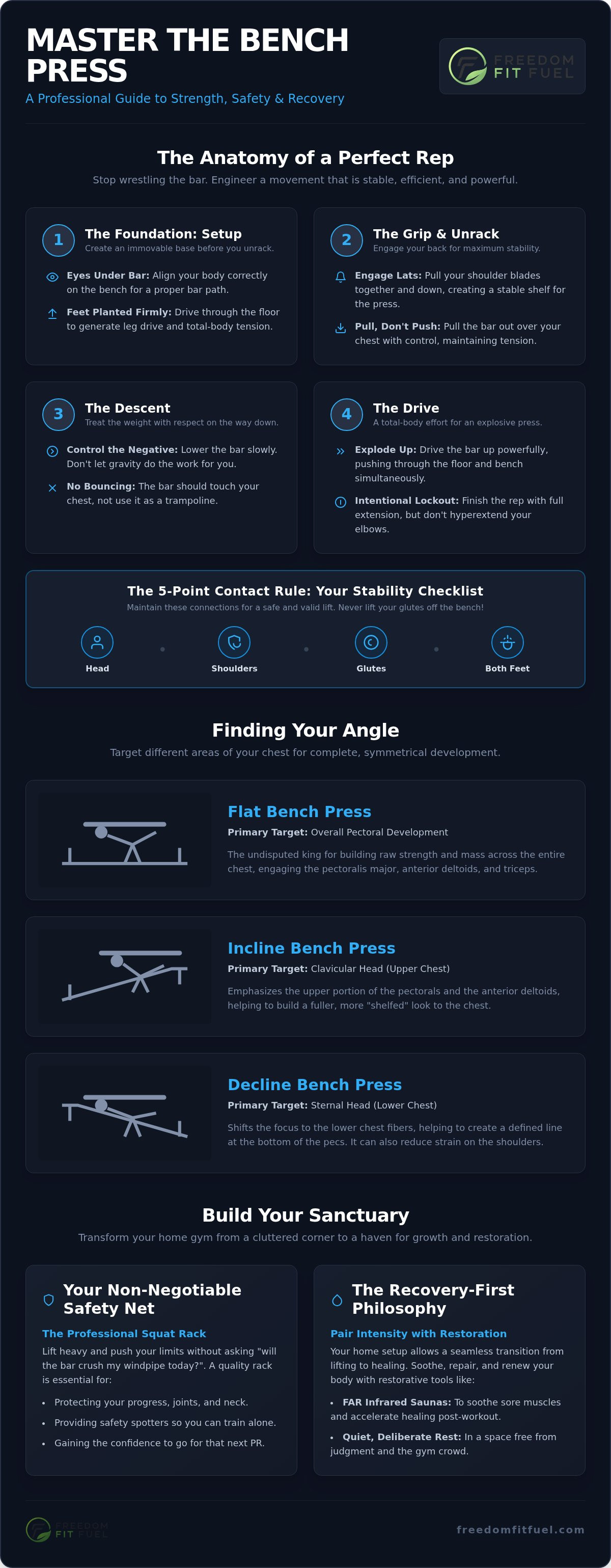
The process begins with a foundation that feels immovable. Position your eyes directly under the bar and plant your feet so firmly they feel like they’re growing roots into the floor. As you prepare for the unrack, don't just shove the bar up. Engage your lats, pull your shoulder blades together, and pull the bar out over your chest. During the descent, treat the weight with respect. Control the bar as it lowers, ensuring it doesn't treat your ribcage like a trampoline. The drive back up should be a total body effort, pushing through the floor and the bench simultaneously before finishing with a lockout that reflects intention rather than a desperate sigh of relief.
The Five-Point Contact Rule
Stability is the silent partner of strength. To maintain a safe and effective press, you must adhere to the five-point contact rule: your head, shoulders, and glutes must remain on the bench, while both feet stay flat on the floor. Lifting your glutes off the bench might feel like it helps you move more weight, but it’s actually a one-way ticket to "Incomplete Rep City" and potential lower back strain. While a natural arch in your lower back is encouraged for stability, your connection to the bench must remain absolute. A sturdy squat rack for home gym setup provides the necessary uprights to ensure your bar path remains consistent within this stable frame.
Grip Width: Finding Your Sweet Spot
Your choice of grip determines whether you are building a massive chest or just making your shoulders angry. A narrow grip shifts the load significantly to your triceps, which is great for arm day but less ideal for a primary chest movement. Conversely, an excessively wide grip can put undue stress on the shoulder capsules. For most humans, the "Goldilocks" grip is just outside shoulder width. This position maximizes pectoral engagement while keeping your joints in a restorative, safe alignment. Experiment with small adjustments to find the width that feels most powerful and pain-free for your unique anatomy.
Finding Your Angle: Flat, Incline, and Decline Variations
Once you've established a base of strength in your squat rack for home gym, it's time to stop thinking in only two dimensions. Your chest is a complex landscape that requires a variety of stimuli to truly flourish. Sticking exclusively to the flat bench is like eating only the crust of a pizza; you're technically getting the job done, but you're missing out on all the flavor. By adjusting the angle of your press, you can target specific fibers, protect your joints, and build a physique that looks powerful from every direction.
The flat bench remains the gold standard for raw strength and overall mass. It's the foundation of your sanctuary. However, the incline bench is what builds the "upper shelf," providing that sought-after fullness that fills out a t-shirt. For those looking to target the lower pecs without the usual shoulder irritation, the decline bench is a secret weapon. Finally, the dumbbell press acts as the independent cousin that refuses to let your dominant side do all the heavy lifting. It fixes imbalances and ensures your strength is as symmetrical as it is impressive.
Incline vs. Flat: The Eternal Debate
This isn't a matter of choosing a favorite child. You need both to achieve a balanced, aesthetic physique that functions as well as it looks. While the flat bench allows for maximum weight, the incline press is essential for targeting the clavicular head of the chest. To manage shoulder strain during high-incline movements, focus on keeping your elbows tucked at a 45-degree angle rather than flared out like a bird trying to take flight. The optimal incline angle for most lifters is typically 30-45 degrees.
The Dumbbell Advantage
Barbells are great for moving massive iron, but they can mask subtle weaknesses. Your dominant side shouldn't do all the work while your weaker side just hangs out for the ride. Dumbbells offer an increased range of motion and a more natural shoulder path, allowing your joints to move through their preferred arc. This freedom of movement is a cornerstone of a recovery-first mindset. Proper organization of these tools is vital for maintaining the tranquility of your space. Learn more about Squat Racks vs Weight Racks: Organizing for Intention to ensure your sanctuary remains a place of focus and flow. A well-placed squat rack for home gym use serves as the anchor for all these variations, giving you the safety to curate, organize, and optimize your path to strength.
Beyond the Rack: The Science of Bench Press Recovery
Racking the bar for the final time on your squat rack for home gym feels like a hard-earned victory. Most lifters walk away from the rack thinking the work is done, but they're wrong. Your muscles don't actually grow while you are straining under the iron; they grow while you are asleep, hydrated, and intentionally resting. Recovery isn't just "not lifting"; it's a deliberate, active phase of the growth cycle that determines whether your next session is a breakthrough or a breakdown. If you want to maximize the investment you've made in your squat rack for home gym, you must invest equally in your downtime.
Active recovery is about more than just sitting on the couch. It involves using targeted tools to flush metabolic waste and repair the micro-tears in your muscle fibers. From deep-penetrating heat to cellular recharging, the way you treat your body after the lift is what turns a simple workout into a lifestyle of personal evolution. Cold plunging, for instance, serves as the ultimate "off switch" for systemic inflammation, constricting blood vessels and leaving you feeling revitalized, refreshed, and ready for whatever comes next.
Infrared Heat: The Body’s Internal Reset
Traditional saunas are excellent if you enjoy breathing in hot, stagnant air, but FAR infrared technology is a far more sophisticated beast. These waves penetrate deep into your chest tissues to soothe, repair, and renew your body from the inside out. We focus on low EMF saunas because your sanctuary shouldn't come with a side of unnecessary electromagnetic radiation. This deep heat therapy promotes hypertrophy by increasing blood flow to the very muscles you just punished in the rack. For a deeper look at the mechanics of restoration, explore our Guide to 2-Person Low EMF FAR Infrared Saunas.
PEMF and the Cellular Recharge
Heavy compound lifts drain more than just your glycogen; they drain your cellular energy. Pulsed Electromagnetic Field (PEMF) technology helps recharge these "cellular batteries," speeding up recovery from heavy sessions in a way that scrolling through social media never will. It is a moment of quiet encouragement for your body, allowing for restoration and internal harmony. Your cells need a real recharge, not just a nap. You can learn more about this technology in our guide, PEMF Mat for Pain Relief: Why Your Cells Need a Recharge.
Elevate your recovery sanctuary by exploring our curated collection of wellness essentials today.
Building Your Sanctuary: Choosing a Squat Rack for Your Home Gym
Selecting a squat rack for home gym use is essentially an act of self-care disguised as a hardware purchase. You want a piece of equipment that is sturdy, reliable, and safe. In a commercial gym, you might have the luxury of a spotter who is only mildly distracted by their own reflection. At home, it is just you and the iron. This makes safety spotter arms the most critical piece of insurance you can own. Let’s be clear; your neck was never designed to be a safety bar, and testing that theory is a remarkably poor way to spend your afternoon. A high-quality rack ensures that your solo sessions remain a source of strength, not a hazard.
Beyond the steel, choosing weights that feel as good as they look is vital for your home sanctuary. High-quality plates and a barbell with a consistent, comfortable knurl turn a grueling session into a tactile and grounding experience. When your equipment feels premium, your effort follows suit. You aren't just building a place to sweat; you are creating an environment that invites intentionality, restoration, and internal harmony. Every piece of gear should contribute to a space that feels organized, inspiring, and complete.
The Foundation: Weight Racks and Squat Racks
A sturdy rack is the most important investment in your fitness journey. It anchors your space and provides the security needed for personal evolution. For those of us who don't live in a literal warehouse, space-saving designs are essential. Look for racks with compact footprints or folding capabilities to ensure your gym doesn't swallow your entire home. For a deeper dive into optimizing your layout, see Small Space Strength: Best Squat Racks for Home Use.
Final Touches for the Mindful Athlete
The atmosphere of your sanctuary dictates the quality of your recharge. Proper lighting and consistent airflow keep the mind sharp, while placing a red light therapy panel nearby is a pro move for immediate post-set recovery. Avoid the "cluttered garage" vibe by organizing your weights with intention. A tidy space leads to a tidy mind, allowing you to focus on the rhythmic balance of your movement. Ready to elevate your home gym? Explore our curated fitness collection and begin your journey toward a more balanced, confident, and empowered version of your daily life.
Elevate Your Strength and Reclaim Your Restoration
Reclaiming the bench press from the noise of the commercial gym means more than just lifting heavy iron; it means lifting with absolute intention. You have learned how to engineer the perfect rep, navigate angles that honor your unique anatomy, and prioritize active recovery through deep heat and cellular recharging. A professional squat rack for home gym serves as the literal and metaphorical anchor for this journey, providing the safety needed to push your limits in a space that feels entirely yours. Your neck will thank you for the spotter arms, even if your ego misses the performative chaos of the public gym crowd.
Transforming a spare room into a sanctuary of strength is a commitment to your long-term wellness. By pairing professional-grade exercise equipment with advanced recovery tools, you create a cycle of growth that is sustainable, effective, and deeply rewarding. We are proud to offer a curated selection of premium recovery and fitness tools, supported by national shipping across the United States and a supportive, expert-led wellness community. Build your ultimate home sanctuary with Freedom Fit Fuel and begin your journey toward a more balanced and confident version of your daily life today.
Frequently Asked Questions
Is bench pressing every day a good idea?
Bench pressing every day is generally a recipe for stagnation rather than strength. Your muscle fibers require a dedicated window of restoration to repair the micro-tears created during a heavy session. Lifting daily often leads to overuse injuries, particularly in the delicate shoulder capsules. Aim for two or three sessions per week. This rhythm allows your body to actually build the tissue you are working so hard to stimulate in your sanctuary.
What should I do if I feel shoulder pain during a bench press?
Stop the movement immediately if you feel sharp or nagging pain. This is usually your body’s way of telling you that your elbows are flared too wide or your shoulder blades aren't properly retracted. You might try switching to dumbbells for a more natural path of motion. After your session, consider using a PEMF mat or a red light therapy panel to soothe the area and encourage internal harmony through cellular repair.
Can I bench press safely at home without a spotter?
You can absolutely bench press alone, but only if you use a squat rack for home gym setups equipped with safety spotter arms. These metal bars act as a mechanical spotter, catching the weight if you reach failure. Never attempt a heavy solo lift without these failsafes in place. Your home gym should be a place of empowerment, not a high-stakes gamble with a heavy barbell and no exit strategy.
How much weight should a beginner start with on the bench press?
Beginners should start with an empty barbell to master the technical nuances of the movement. Most standard Olympic bars weigh 45 pounds, which is plenty for learning the "J-curve" bar path and the five-point contact rule. Don't worry about impressing the walls of your garage. Focus on intentionality and form first. Once the movement feels like a rhythmic, balanced conversation between your mind and muscles, you can gradually add small increments of weight.
What is the difference between a barbell and dumbbell bench press?
The barbell allows you to move the most total weight, making it the gold standard for raw power. In contrast, dumbbells require more stabilization and offer a greater range of motion. Using dumbbells helps identify and fix muscle imbalances where one side might be doing more work. Integrating both tools into your routine ensures your physique is as symmetrical as it is strong, creating a sense of completeness in your training.
How do I know if my bench press form is correct?
Correct form feels stable, powerful, and pain-free. You should maintain the five-point contact rule: head, shoulders, and glutes on the bench with both feet planted firmly like roots. The bar should touch your lower chest and move in a slight arc back toward your eyes. If your butt is lifting or your feet are dancing, you’ve lost the intentionality of the rep. Record yourself occasionally to curate your technique and ensure long-term joint health.
Does using a sauna after bench pressing help with muscle soreness?
Using a FAR infrared sauna is an exceptional way to flush metabolic waste and reduce delayed onset muscle soreness. The deep-penetrating heat increases circulation, delivering fresh oxygen to the chest and triceps. This restorative process moves you from a state of physical stress to one of soothing tranquility. It is the ultimate way to close a session in your squat rack for home gym, ensuring you feel renewed and ready for your next evolution.
What are the best safety features to look for in a squat rack for a home gym?
Prioritize heavy-duty safety spotter arms and J-hooks with protective liners to preserve your barbell’s knurling. A wide, stable base is essential to prevent the rack from shifting during a heavy unrack. Look for 11-gauge steel construction to ensure the frame won't give up on you mid-set. These features turn a simple piece of equipment into a reliable partner in your personal growth, allowing you to lift with total confidence and peace of mind.