

Weight Rack vs. Squat Rack: Choosing the Foundation for Your Home Sanctuary
Why does your home gym look like a disorganized scrap metal yard when the rest of your house feels like a curated sanctuary for Zen living? It's a frustrating paradox to balance the raw grit of iron with the quiet grace of a wellness retreat. You want a space that allows you to breathe, move, and evolve without constantly tripping over stray plates or stubbing your toe on a dumbbell. Selecting the right weight rack is about more than just clearing the floor; it's about building a foundation that feels intentional, restorative, and sophisticated.
You've likely realized that industrial, clunky equipment has a way of ruining the vibe of a room faster than a bad playlist. It's difficult to find that sweet spot between professional-grade durability and a mindful aesthetic, especially when you're confusing storage shelves for actual lifting stations. We'll show you how to distinguish between these tools so you can organize, elevate, and inspire your daily routine. This guide provides the clarity you need to choose equipment that supports heavy lifting while maintaining the tranquility of your home sanctuary.
Key Takeaways
- Learn the difference between a storage-focused weight rack and a structural squat rack so you don't end up with an expensive, heavy shelf you can't actually lift from.
- Discover how banishing floor clutter saves your toes and your sanity, transforming a chaotic room into a legitimate wellness retreat.
- Identify the "gold standard" materials, like powder-coated steel, that ensure your equipment survives your progress without looking like an industrial eyesore.
- Explore how a tidy strength station sets the stage for a restorative post-lift ritual, seamlessly moving you from heavy sets to a soothing infrared sauna session.
The Gravity of the Situation: What is a Weight Rack (and Why Do You Need One)?
Your home gym should be a place of restoration, not a high-stakes obstacle course where you're one misstep away from a date with an orthopedic surgeon. A weight rack is more than just a metal shelf; it's the guardian of your progress and the curator of your space. When your environment is chaotic, your mind follows suit. Leaving 50lb dumbbells scattered across the floor isn't just a design flaw; it's a recipe for a 2026 ER visit that your insurance provider will definitely judge you for.
We believe in the sanctuary philosophy. Every tool you use to better yourself deserves a home that reflects its value. If you treat your equipment like junk, your brain will eventually treat your workout like a chore. A dedicated storage solution brings a sense of order to your training, allowing you to focus on the movement rather than the mess. It's about creating a space that invites you in rather than one you have to navigate with caution.
The Three Pillars of Rack Utility
Think of your rack as the skeletal system of your fitness retreat. It provides the structure necessary for everything else to function smoothly. Here is why it matters:
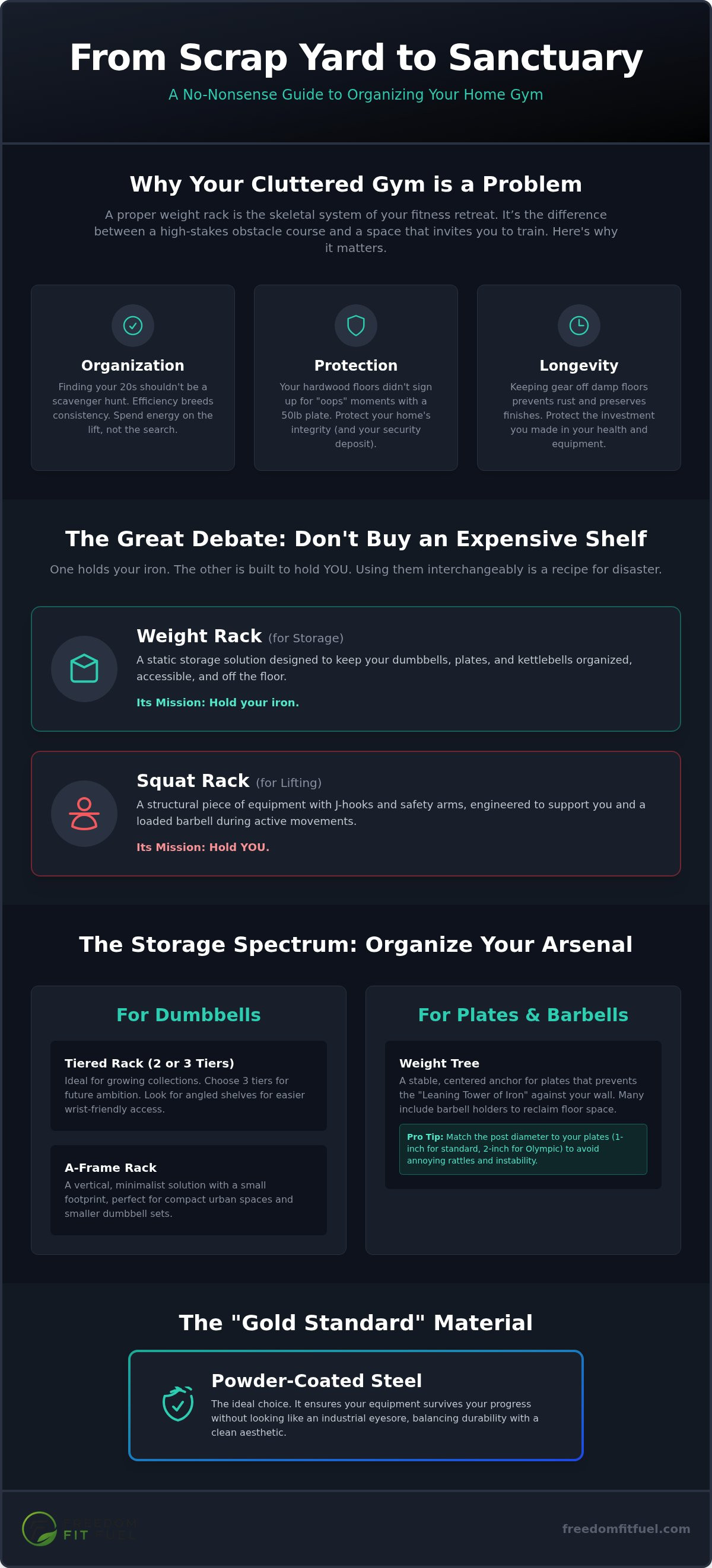
- Organization: Finding your 20s shouldn't feel like a high-stakes scavenger hunt in a scrap yard. Efficiency breeds consistency. When everything has a place, you spend your energy on the lift, not the search.
- Protection: Your hardwood floors didn't sign up for the inevitable "oops" moment when a heavy plate slips from your grip. A rack keeps the impact where it belongs and protects your home's integrity.
- Longevity: Keeping weights off the damp floor or abrasive concrete extends the life of your gear. It prevents rust, preserves finishes, and keeps your investment looking pristine.
Weight Rack vs. Squat Rack: A Quick Distinction
The internet loves to use these terms interchangeably, which is a bit like calling a bookshelf a ladder. While a Power rack is designed to support the weight of a human and a loaded barbell during active movement, the humble storage rack has a different mission. A weight rack is a static storage solution for free weights. It's built for stability and accessibility, ensuring your dumbbells and plates stay exactly where you put them until you're ready to pick them up again. Squat racks are for holding you; weight racks are for holding your iron.
The Storage Spectrum: Dumbbells, Plates, and the Art of Not Tripping
Your home sanctuary should feel like a place of renewal, but it's hard to find your center when you're playing hopscotch over cast iron. A quality weight rack transforms your floor from a hazard zone into a professional, organized retreat. Whether you're managing a growing collection of dumbbells or a stack of bumper plates, selecting the right storage is an act of self-care. It protects, organizes, and elevates your entire environment. This intentionality allows you to focus on your recovery rather than the clutter beneath your feet.
Dumbbell Racks: Choosing Your Tier
Choosing between a two-tier and a three-tier rack is mostly an exercise in honesty regarding your future ambition. If you plan to expand your strength journey, a three-tier model offers the breathing room you'll eventually need for those heavier sets. For those in compact urban spaces, A-frame racks provide a vertical, minimalist solution that keeps your footprint small. Look for angled shelves; they facilitate a more natural grip and reduce strain on your wrists during the transition from rest to work. Prioritizing weight training safety means ensuring your gear is accessible and secure, not buried under a pile of laundry or hidden in a dark corner.
The Weight Tree: Organizing Your Plates
Bumper plates are notoriously difficult to stack without creating a "Leaning Tower of Iron" that threatens your baseboards. A weight tree provides a centered, stable anchor for your Olympic or standard plates. Always check the post diameter before you commit. Shoving a 2-inch Olympic plate onto a 1-inch standard post is a recipe for annoying rattles and instability. Many modern trees also include vertical barbell holders, which is a brilliant way to reclaim precious floor space in a multi-purpose room. This level of organization allows you to flow through your routine with grace and focus.
Kettlebells are the toddlers of the gym; they're round, heavy, and prone to rolling away if left on a flat shelf without a protective lip. Multi-purpose racks act as the Swiss Army Knife of your sanctuary, offering flat tiers for bells and traditional rails for dumbbells. This curated approach to storage ensures every piece of equipment has a home, making your post-workout recharge much more rewarding. If you're ready to bring order to the chaos, exploring a high-quality weight rack is the first step toward a more balanced daily life.
The Great Debate: Weight Rack vs. Squat Rack for Your Home Sanctuary
Deciding between a storage-focused weight rack and a structural squat rack is essentially a choice between how you want to live and how you want to lift. One keeps your sanctuary serene and organized; the other is a massive hunk of steel designed to stop several hundred pounds of gravity from crushing your chest. It's a classic case of form versus function, though the best setups often find a way to marry the two without making your spare bedroom look like a maximum-security prison. Choosing the wrong one is an expensive mistake that leads to either a cluttered floor or a structural cage you never actually use.
Your footprint is the most honest metric you have. How much of your sanctuary are you willing to sacrifice to the gods of iron? A squat rack demands a significant amount of "functional depth," meaning you need room to move around it, inside it, and through it. In contrast, a weight rack is happy to sit quietly against a wall, performing its duty as a silent curator of your equipment. Budgeting for these tools also requires a shift in mindset. You're either paying for the peace of mind that comes with organization or the physical safety required for heavy, solo lifting sessions.
When to Choose a Simple Weight Rack
If your routine centers on high-volume dumbbell work or the fluid, controlled movements of a Pilates Reformer, a heavy-duty power cage is probably overkill. You don't need a four-post steel fortress to hold a pair of fifteen-pounders. A minimalist weight rack preserves your floor space and maintains an open, airy aesthetic that invites restoration. It's the ideal choice for smaller rooms where every square inch is sacred and you'd rather not spend your morning commute dodging structural crossbeams. It's about keeping the energy of the room light and focused on movement rather than heavy machinery.
When the Squat Rack is Non-Negotiable
However, if the barbell is your primary tool for building resilience, a squat rack is your safety net. You can't safely perform a heavy back squat or a bench press alone without the security of safety pins. These racks are built for action, not just storage. They catch failed reps and provide the structural integrity required for powerlifting or high-intensity functional fitness. While they have a larger footprint, the peace of mind they offer during a solo session is worth the sacrifice of a few square feet. If you're training for power and resilience, the cage becomes the center of your world.
Measuring Your Ambition: How to Choose a Rack That Actually Fits
Measuring your space is the unglamorous, slightly tedious ritual that prevents your home sanctuary from becoming a logistics nightmare. It's easy to get swept up in the aspirational glow of a new fitness routine, but your ambition needs to physically fit within your four walls. Before that delivery truck arrives, take a moment to measure your ceiling height and floor space. There is nothing quite as humbling as realizing your new equipment is three inches too tall for your basement or so wide that you have to shimmy past it like an uncoordinated cat to reach the door.
Calculating Your Load Requirements
Don't just account for the weights you have today. Aim for a total weight capacity that is at least 20% higher than your current collection. This strategic buffer gives your progress room to breathe, grow, and evolve without the constant fear of structural failure. Shelf depth is equally vital; those 100lb "monsters" shouldn't be hanging off the edge like they're auditioning for a circus act. Look for a weight rack with rubberized feet. These small additions protect your floors, dampen noise, and provide the peace of mind needed for a truly restorative environment.
Aesthetic and Durability
Material matters when you're curating a space for recovery. Powder-coated steel is the gold standard for home gym elegance because it resists scratches, prevents rust, and looks sophisticated. High-quality racks use 11-gauge or 14-gauge steel for residential stability. When choosing a finish, consider whether you prefer matte black or chrome. While chrome is classic, matte black is far superior at hiding the inevitable sweat and fingerprints of a hard session. You'll also face the choice between welded and bolted joints. Welded joints offer superior structural integrity, while bolted joints are much easier to ship and assemble without needing a professional crew.
Assembly anxiety is real, but it shouldn't stop you from building your retreat. Most modern designs are intuitive enough that you won't lose your mind with an Allen wrench, provided you follow the instructions and take your time. If you're ready to invest in a foundation that matches your dedication and aesthetic, you can learn more about our commitment to quality on our about us page. Choosing a weight rack is the first step in organizing your strength journey with intentionality and care.
The Freedom Fit Fuel Standard: Elevating Your Strength Sanctuary
Most fitness brands want you to live in a state of perpetual, sweaty aggression. At Freedom Fit Fuel, we prefer a more civilized approach to home fitness. We curate professional-grade equipment like the weight rack because we know that a disorganized room leads to a disorganized mind. Strength is only half of the equation for a balanced life. A true sanctuary integrates the raw power of lifting with the restorative science of infrared saunas. It's about building a body that is as resilient as it is relaxed, without the industrial eyesores typical of traditional gyms.
Imagine finishing your final heavy set and transitioning seamlessly from your rack to a cold plunge tub. The point isn’t showing off your discipline. It’s intentional recovery. We've moved past the "bro-gym" vibe where the only metric of success is how much noise you make when you drop a plate. By selecting gear that looks as good as it performs, you create an environment that supports your evolution without clashing with your home's aesthetic. Your equipment should be a source of pride, not something you hide behind a curtain when guests arrive.
The Holistic Home Gym
Balancing the heavy strain of lifting with cellular recovery is the hallmark of a modern, mindful athlete. Utilizing PEMF mats allows your body to recharge at a level that a simple nap simply can't reach. Every square inch of your space should facilitate a logical flow between effort and ease. If you want to dive deeper into how we've curated this holistic experience, you can learn more about our mission on our About Us page. We don't just sell iron; we provide the tools for a more confident and restored version of your daily life.
Ready to Organize Your Journey?
Your fitness goals for 2026 and beyond deserve a foundation that doesn't wobble, rust, or ruin the vibe of your room. Choosing a weight rack that grows with you is a long-term commitment to your physical and mental health. Don't settle for a cluttered "workout room" when you could have a true wellness sanctuary. Our supportive guides are available to help with personalized gym layout advice, ensuring your equipment fits your specific floor plan and lifestyle. It's time to build a space that fuels your freedom, supports your growth, and restores your spirit.
Your Sanctuary Awaits: Building a Foundation for Progress
Choosing between a storage-focused weight rack and a structural squat rack is the final step in reclaiming your home from the chaos of stray iron. It's time to banish the mental clutter of disorganized equipment. You've learned that organization is a fundamental part of your self-care ritual; it prevents injuries and keeps your room from looking like a scene from a low-budget action movie. Whether you need a minimalist vertical solution or a robust cage for heavy barbell work, your selection should reflect the value you place on your recovery.
We curate professional-grade equipment specifically for the mindful home wellness enthusiast. Our goal is to ensure your gear supports both high-intensity effort and soothing restoration. Our supportive guides are ready to help you design a space that feels intentional, sophisticated, and entirely yours. With national shipping across the United States, your journey toward a more balanced daily life is closer than you think.
Explore Our Curated Collection of Weight Racks and Squat Racks
You deserve a space that inspires renewal and fuels your freedom. Let's build it together.
Frequently Asked Questions
What is the difference between a weight rack and a squat rack?
A weight rack is primarily a storage unit designed to keep your dumbbells and plates organized and off the floor. In contrast, a squat rack is a structural piece of equipment built to support a barbell and the lifter during active movements like squats or presses. While one keeps your sanctuary tidy, the other keeps you safe from being pinned by a heavy bar. It's the difference between a high-end bookshelf and a construction scaffold.
How much weight can a standard home weight rack hold?
Most residential weight racks are engineered to hold between 400 and 1,000 pounds, depending on the material gauge and design. For a mindful home sanctuary, look for racks constructed from 11-gauge or 14-gauge steel to ensure stability. Always check the manufacturer's specific rating before loading it up. It's better to have a 20% buffer than to watch your equipment slowly bow under the pressure of your growing ambition and iron collection.
Do I really need a weight rack if I only have a few dumbbells?
Even a small collection of weights deserves a dedicated home to prevent your workout room from becoming a trip hazard. A compact weight rack preserves your floor's integrity and maintains the calming aesthetic of your wellness retreat. Tripping over a stray 15-pound dumbbell while trying to find your Zen is a quick way to ruin the vibe. Organization fosters intentionality, making it easier to transition from movement to recovery without dodging metal obstacles.
What is the best weight rack for a small apartment or limited space?
Vertical A-frame racks are the gold standard for small apartments because they utilize height rather than floor real estate. These designs allow you to stack multiple pairs of dumbbells in a footprint no larger than a standard floor lamp. They keep your equipment accessible while preserving the open, airy feel of a multi-purpose room. If your square footage is sacred, going vertical ensures your strength journey doesn't crowd out your space for restorative stretching or meditation.
How do I maintain my weight rack to prevent rust and wear?
Maintaining your rack is a simple act of equipment self-care that involves regular cleaning and environmental control. Wipe down the steel with a dry or slightly damp microfiber cloth after every session to remove corrosive sweat and moisture. If you live in a humid climate, using a dehumidifier in your gym space helps prevent oxidation. High-quality powder-coated finishes are resilient, but keeping them dry ensures your investment remains a beautiful part of your sanctuary.
Can I store kettlebells on a standard dumbbell rack?
You can store kettlebells on a weight rack if it features flat shelves, but traditional dumbbell rails are often too narrow and unstable. Kettlebells have a rounded base and a high center of gravity, making them prone to rolling if not placed on a solid, level surface. For a holistic gym, consider a multi-purpose rack that offers both rails for your dumbbells and flat tiers specifically designed to house your kettlebells and medicine balls safely.
Is it difficult to assemble a weight rack by myself?
Most home storage racks are designed for straightforward solo assembly and usually require nothing more than a basic wrench set and some patience. While a squat rack might benefit from a second pair of hands due to its height and heavy crossbeams, a standard storage rack is quite manageable. Just follow the instructions carefully to avoid the sarcasm of a leftover bolt. Taking your time ensures the structure is level, stable, and ready for use.
Should I get a vertical or horizontal weight rack for my home gym?
Choose a vertical rack if space is your primary constraint, but opt for a horizontal tier rack if you prioritize quick accessibility and a professional gym aesthetic. Horizontal racks allow you to see your entire collection at a glance, which is helpful for fast-paced circuits. However, they require a wider wall footprint. Vertical options are more discreet and fit perfectly into corners, making them ideal for those who want their equipment to complement rather than dominate the room.