

Red Light Panel Therapy: The Science of Cellular Rejuvenation (and Looking Less Like a Raisin)
What if the most effective way to reverse that post-workout "creaky hinge" feeling and smooth out those fine lines wasn't found in a $200 jar of cream, but in a specific beam of invisible light? It's genuinely exhausting to stare at a shelf of serums that promise the world while your muscles take three business days to recover from a single gym session. You've likely heard the buzz about red light, but the mountain of conflicting data on wavelengths and power outputs is enough to make anyone want to retreat back to their raisin-like existence. It's time for some clarity.
You deserve a wellness ritual that prioritizes intentionality, restoration, and genuine results. We're diving deep into the technical specifications and near infrared led therapy benefits that transform a simple LED panel into a cellular powerhouse for recovery and radiance. This guide explores the biological mechanisms that allow photons to "recharge" your system, helping you achieve faster recovery times and improved skin elasticity. We'll break down exactly how to move from confusion to a routine grounded in the research that leaves you feeling balanced, restored, and remarkably un-raisin-like.
Key Takeaways
- Understand the science of photobiomodulation and how specific light frequencies "recharge" your cellular batteries to keep you from looking like a sun-dried fruit.
- Explore the near infrared led therapy benefits that accelerate muscle recovery and stimulate collagen synthesis for a more radiant, resilient version of yourself.
- Decode technical specifications like irradiance and flicker rates to ensure your home device offers clinical-grade power rather than just a festive, expensive glow.
- Establish a balanced restoration ritual by mastering the optimal timing and distance required for effective cellular rejuvenation.
The Science of Photobiomodulation: How Near Infrared LED Therapy Actually Works
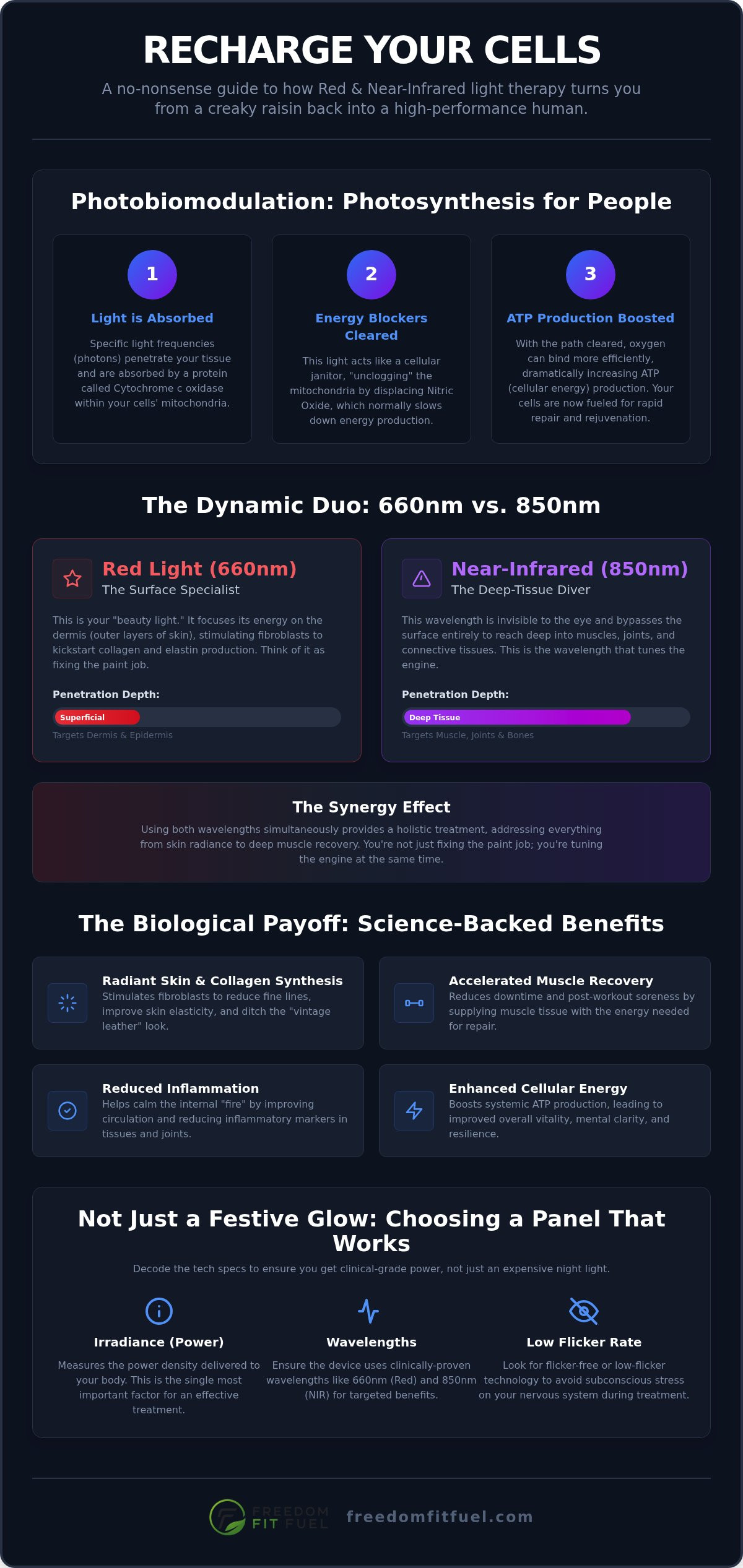
Photobiomodulation sounds like a word invented by a sci-fi novelist to explain how aliens stay young, but it's actually a grounded biological process. At its core, The Science of Photobiomodulation describes a non-invasive cellular "recharge" where specific light frequencies interact with your biology. Think of it as photosynthesis for humans, minus the need to stand in a pot of dirt. While your skin might feel a gentle warmth, the real work happens at the microscopic level where your cells are essentially "drinking" the light to perform better. This is where the primary near infrared led therapy benefits begin, moving past the surface to influence how your body handles everything from inflammation to energy production.
Cytochrome c oxidase is the star of the show here. It's a protein in your mitochondria that specifically absorbs red and near-infrared light. When these photons hit the receptor, it's like flipping a switch that tells the cell to stop being lazy and start repairing. It's the difference between a sluggish recovery and a body that feels ready for a second workout. Without this interaction, your cells are just waiting for the slow, traditional recovery process to take its course. It's a bit like trying to run a marathon on a diet of crackers; you'll get there, but it won't be pretty.
Red Light (660nm) vs. Near-Infrared (850nm)
Not all light is created equal. The 660nm wavelength is your surface specialist, focusing its energy on the dermis to encourage collagen synthesis and skin health. It's the "beauty light" that keeps you from looking like a piece of vintage leather. In contrast, the 850nm wavelength is a deep-tissue diver. It bypasses the surface entirely to reach the mitochondria in your muscle fibers and connective tissues. This deep penetration is one of the key near infrared led therapy benefits that athletes and weekend warriors swear by for reducing downtime. When you use both simultaneously, you create a "Synergy Effect" that addresses the body holistically. You aren't just fixing the paint job; you're tuning the engine at the same time.
The Mitochondrial "Battery" Metaphor
Your cells have tiny power plants called mitochondria. Normally, these plants can get "clogged" by nitric oxide, which slows down energy production and leaves you feeling like a phone on 1% battery. Light therapy acts as a cellular janitor, clearing out the nitric oxide so oxygen can bind to Cytochrome c oxidase. This allows your system to shift from a state of emergency repair to optimal maintenance. Photobiomodulation optimizes cellular respiration to significantly increase ATP production, providing the fuel necessary for rapid tissue repair and systemic restoration. More energy means your cells spend less time struggling to survive and more time thriving. It's a simple, elegant way to support your body's natural urge to heal without the high-pressure urgency of more aggressive treatments.
The Biological Payoff: Near Infrared LED Therapy Benefits
While the science of light receptors is fascinating, you're likely here because you want to stop feeling like a creaky floorboard. The real-world near infrared led therapy benefits extend far beyond just feeling warm for ten minutes. We're talking about systemic shifts that influence the depth of your wrinkles, the speed of your sprint, and the clarity of your mind. It's about calming the internal "fire" of chronic inflammation while helping your body remain radiant, resilient, and restored. It's a way to reclaim your vitality without having to spend your entire weekend in a recovery clinic.
The beauty of this technology lies in its versatility. Whether you're trying to outrun the aging process or just trying to survive a particularly brutal CrossFit session, light therapy offers a non-invasive path forward. It's an empowering tool for anyone who's tired of the "quick fix" culture and ready for something that actually works at a cellular level. It turns out that standing in front of a high-powered light panel is one of the few things in life that's both incredibly lazy and scientifically productive.
Radiant Skin and Collagen Synthesis
If your current skincare routine involves a prayer and a very expensive moisturizer, it's time to introduce 660nm light to your fibroblasts. These are the cells responsible for collagen, and they respond to red light like a parched plant responds to rain. By stimulating these cells, you aren't just masking fine lines; you're encouraging the skin to actually rebuild itself from the inside out. This process helps reduce redness, clear up stubborn acne, and erase that "I slept three hours" look that coffee can't quite fix. For those ready to dive deeper into the aesthetic side, exploring Red light therapy for skin can transform your daily ritual into a clinical-grade experience.
Muscle Restoration and Athletic Performance
We've all been there: the day after a leg workout when the stairs feel like an impossible mountain range. This is where near-infrared light truly shines. By using NIR light post-workout, you're actively reducing oxidative stress and the dreaded delayed onset muscle soreness (DOMS). It's a significantly more sophisticated alternative to the "frozen pea" method; while ice just numbs the pain, light actually facilitates the repair. Some users even prefer a pre-workout session to prime the muscles for the stress ahead. You can learn more about why Red light therapy for muscle recovery is the partner your gym bag is missing. If you're tired of the guesswork and ready for a professional-grade solution, the Ultra Series panel offers the high irradiance needed to see genuine, lasting results.
The Buyers Framework: Selecting a Red Light Panel That Actually Performs
Shopping for a red light panel is often a journey through a swamp of buzzwords and questionable internet listings. You're looking for genuine cellular rejuvenation, not a glorified Christmas decoration that does nothing but take up space on your nightstand. To unlock actual near infrared led therapy benefits, you have to move past the aesthetics and look at the engineering. A panel is more than just a box of red bulbs; it's a precision instrument. If the manufacturer can't provide a detailed spec sheet, they're likely selling you a flashlight with a fancy price tag. It's time to demand more from your wellness tools.
The difference between a clinical-grade device and a cheap knockoff comes down to four pillars: power, stability, safety, and coverage. You shouldn't need a degree in optical physics to buy a recovery tool, but knowing the basics will save you from wasting money on underpowered gear. We're looking for a device that offers the horsepower to reach deep tissues while maintaining a gentle, supportive environment for your nervous system. It's about finding that delicate balance between high-intensity output and holistic safety.
Decoding Irradiance and Power Density
Irradiance is the actual "horsepower" of your panel. Measured in milliwatts per square centimeter (mW/cm²), it tells you how many photons are actually hitting your skin. A high-wattage panel doesn't always mean high-intensity light; often, that wattage is just heat being wasted by inefficient fans. You want high power density so the light can penetrate through the dermis and reach the underlying muscle. This is where the most significant near infrared led therapy benefits are found, specifically in deep-tissue restoration and inflammation control.
Distance matters because of the Inverse Square Law. If you double your distance from the panel, you don't just lose half the power; you lose 75% of it. This is why professional-grade reference sheets are essential. They show you exactly what dose you're receiving at six, twelve, or eighteen inches. Without this data, you're just guessing, and your cells deserve better than a "vibe-based" recovery protocol.
Low EMF and Safe Circuitry
There is a profound irony in using a wellness tool that bathes you in "dirty electricity" or high electromagnetic fields (EMF). While you're trying to heal your mitochondria, a high-EMF device could be stressing your system. Freedom Fit Fuel prioritizes low-EMF components and shielded internal wiring to ensure your session is actually restorative. We believe in safety, efficiency, and intentionality in every circuit. By choosing a panel with low-flicker drivers and shielded components, you avoid the headaches and eye strain often associated with cheaper LEDs. Your home wellness ritual should be a sanctuary of calm, not a source of invisible electrical stress.
The Ritual of Restoration: How to Use Your Panel Like a Pro
Owning a professional-grade LED panel is a fantastic first step, but don't just treat it like a piece of high-tech decor. It's not a lava lamp. While it's tempting to simply flip the switch and hope for the best, maximizing the near infrared led therapy benefits requires a bit more intentionality than just standing nearby. Think of your sessions as a "cellular Goldilocks zone." Too little time and your mitochondria won't receive the signal to recharge; too much and you might hit a point of diminishing returns where the cells simply stop responding. It's about finding that perfect middle ground where restoration feels effortless and effective.
Consistency is the secret sauce that turns a sporadic habit into a life-changing ritual. Your cells love a predictable schedule. Most users find that daily sessions, or at least five days a week, yield the most noticeable shifts in energy and skin tone. Regarding eye safety, treat the light with respect. While the red glow is generally soothing, the near-infrared spectrum is invisible and powerful. Unless you're specifically targeting the area around your eyes with your lids closed, wearing the provided blackout goggles is a smart move. It's a simple way to ensure your restoration ritual remains entirely supportive and stress-free.
Protocols for Skin vs. Deep Tissue
Your distance from the panel dictates the "dose" your body receives. If you're focusing on the surface, such as smoothing out fine lines or reducing redness, stay about 6 to 12 inches away for 10 minutes. This allows the 660nm light to saturate the dermis without being too intense. However, if you're targeting those deep-tissue diver wavelengths where near infrared led therapy benefits are most profound for systemic inflammation, you might move closer or extend the session to 20 minutes. For those dealing with persistent discomfort, understanding how to apply Red light therapy for pain can help you tailor your distance for maximum penetration.
Stacking Your Recovery: Red Light and Beyond
True wellness advocates know that the best tools work better together. You can create a comprehensive recovery sanctuary by stacking your light session with other restorative habits. Many find that using their panel while relaxing on a PEMF mat creates a synergistic effect that recharges the body's electrical and light-based systems simultaneously. If you're a fan of heat, following up your session with time in infrared saunas can deepen the detoxification process and leave you feeling completely renewed. It's about building a home wellness ritual that feels like a premium retreat. To start building your own clinical-grade recovery station, explore the Ultra Series LED panels and experience the difference of high-irradiance engineering.
The Ultra Series Difference: Freedom Fit Fuel LED Panels
By now, you've navigated the microscopic world of mitochondria and learned why your cells are basically light-hungry batteries. You understand the science, you've seen the data, and you're ready to stop looking like a piece of sun-dried fruit. The only thing standing between you and cellular rejuvenation is the hardware. This is where the Ultra Series Red & Near-Infrared LED Therapy Panel enters the conversation. It isn't just another light box; it's a piece of high-irradiance engineering designed to bring clinical-grade results into the sanctuary of your own living room. We've taken the guesswork out of the equation so you can focus on the actual restoration.
The Ultra Series utilizes a sophisticated dual-chip advantage, delivering both 660nm and 850nm wavelengths in a single, powerful array. This means you don't have to choose between surface-level skin health and deep-tissue muscle recovery. You get both. At Freedom Fit Fuel, we act as your trusted curator, selecting only the tools that meet our rigorous standards for low-EMF output and high power density. We believe that your home wellness ritual should be rooted in authenticity, quality, and genuine care. It's about providing the horsepower necessary to Get the full spectrum of near infrared led therapy benefits without the technical headaches.
Crafted for Longevity and Performance
We believe that a recovery tool should be as resilient as the body it's helping to heal. The Ultra Series is built with robust internal components, including quiet cooling fans and a modular design that allows for seamless integration into your space. Whether you're mounting it in a dedicated home gym or keeping it tucked away in a bedroom, the build quality is unmistakably premium. Because let's be honest: your recovery equipment shouldn't look like a science fair project built by a caffeinated middle schooler. It's a professional-grade instrument that offers precision, power, and performance in every session. This focus on durability ensures that your investment in health continues to pay dividends for years to come.
Your Journey to Radiant Health Starts Here
Integrating the Ultra Series into a busy lifestyle is remarkably simple. You don't need to carve out hours of your day; a focused 10 to 20 minute session is all it takes to signal your cells to begin the work of repair and renewal. We're committed to your empowerment, providing the tools you need to take control of your own recovery journey. By prioritizing low-EMF restoration and national US shipping, we ensure that clinical-grade wellness is accessible to everyone, regardless of their zip code. If you're ready to experience the near infrared led therapy benefits for yourself and move toward a more balanced version of daily life, it's time to take the next step. Explore the Ultra Series Panels and discover how intentional light can redefine your restoration ritual.
Step Into Your Cellular Glow
You've moved from being a curious observer to a well-informed advocate for your own cellular health. You now know that photobiomodulation isn't magic; it's a precise biological "recharge" that turns sluggish mitochondria into high-performing power plants. By prioritizing high-irradiance output and avoiding the headache-inducing flicker of cheap knockoffs, you're choosing a path of intentionality and restoration. Embracing the full spectrum of near infrared led therapy benefits means you're no longer settling for surface-level fixes. You're investing in a ritual that supports your muscles, your skin, and your overall vitality.
It's time to stop overthinking the science and start feeling the results. Whether you're chasing faster recovery times or just want to avoid looking like a piece of vintage luggage, the right hardware makes all the difference. Our Ultra Series features low EMF certified components and high-irradiance output for maximum cellular absorption. With national US shipping and dedicated support, your journey toward a more radiant version of yourself is just a few clicks away.
Upgrade Your Recovery with the Ultra Series LED Panels
Your cells are ready for their upgrade. It's time to give them the light they deserve and enjoy the calm, restorative energy you've been searching for.
Frequently Asked Questions
Is red light panel therapy safe for my eyes?
Yes, red light is generally safe, but your eyes aren't fans of staring directly into a high-powered sun. While red light (660nm) is just very bright, near-infrared (850nm) is invisible and can penetrate deeper. We recommend using the provided blackout goggles during your session. It's a simple way to keep your restoration ritual focused, safe, and entirely supportive of your long-term vision without any unnecessary risks.
How long does it take to see benefits from near infrared led therapy?
You might feel a gentle warmth and improved mood immediately, but true near infrared led therapy benefits require a bit of patience. For muscle recovery and inflammation, most users notice a difference within two to four weeks of consistent use. Skin rejuvenation and collagen production take longer, typically eight to twelve weeks. Your cells are rebuilding a foundation, not just applying a temporary mask, so give them time to work.
Can I use red light therapy every day?
Daily use is not only allowed; it's actually encouraged for the best results. Your mitochondria thrive on a steady, predictable rhythm of restoration. Most people find that a 10 to 20 minute session once a day is the perfect "Goldilocks" zone. Consistency turns a simple light session into a powerful habit that keeps your energy levels balanced, resilient, and restored. Just don't feel the need to spend all day in front of it.
Do I need to be naked for red light therapy to work?
Light needs direct access to your skin to work its magic. Red and near-infrared photons can't efficiently penetrate through denim or thick sweaters. For maximum absorption, the targeted area should be bare. If you're shy, a thin, light-colored fabric might allow some light through, but you'll be sacrificing the potency of your session. It's best to embrace the vulnerability for the sake of your cellular health and total restoration.
What is the difference between red light and near-infrared light?
The primary difference is the depth of penetration and the intended goal. Red light (660nm) is a surface specialist, focusing on the dermis to boost collagen and smooth out fine lines. Near-infrared light (850nm) is a deep-tissue diver that reaches your muscles and joints. Our Ultra Series panels use a dual-chip array to deliver both simultaneously, ensuring your recovery is holistic, comprehensive, and effective from the surface to the bone.
Can red light therapy help with weight loss?
Red light therapy isn't a magic wand for weight loss, but it's a fantastic supportive partner. Some research suggests that these wavelengths can help fat cells become more permeable, allowing them to release their contents more easily during exercise. It also supports the metabolic health needed for a lean, vibrant body. Think of it as a tool for optimization and restoration rather than a replacement for your Pilates reformer or squat rack.
Is there such a thing as "too much" red light therapy?
Yes, there is a point where more light isn't better. This is known as the biphasic dose response. If you stay in front of the panel for an hour, your cells might actually stop responding to the stimulus. Stick to the recommended 10 to 20 minutes per session. It's about quality, intentionality, and biological signaling. Overloading your system just creates stress, which is the opposite of the calming, restorative experience we aim for.
How do I know if my red light panel is powerful enough?
You need to look at the irradiance, which is measured in mW/cm². A quality panel should provide high power density at a distance of at least six inches. If the manufacturer doesn't list these specs, they're likely selling you an expensive nightlight. The Ultra Series is engineered for high-irradiance output, ensuring you receive the maximum near infrared led therapy benefits possible. Always demand a clear, professional-grade reference sheet before trusting a device with your recovery.