

Red Light Therapy: Stop Your Brain Thinking It's Noon
Your living room at 9 PM is currently gaslighting your brain into believing it's a sunny Tuesday in July. Between the overhead LEDs and the blue light bleeding from your smartphone, your pineal gland is essentially under house arrest. It's no wonder you wake up feeling like a caffeinated zombie, nursing a headache, and dreading the day ahead. You've likely tried every herbal tea and white noise machine on the market, yet the 3 AM ceiling-staring marathon remains your unwanted Olympic sport. Using red light therapy for sleep offers a way to reclaim your evening, restore your rhythm, and finally silence the internal noise.
We understand that you want a life that feels balanced, vibrant, and intentional. You deserve a bedroom that acts as a sanctuary rather than a high-voltage interrogation room. In this guide, we'll explore how the Ultra Series Red & Near-Infrared LED Therapy Panel can fix your broken circadian rhythm by protecting your natural melatonin. You'll discover why your current routine is a literal retinal assault and how to curate a wind-down ritual that's restorative, calming, and genuinely effective. It's time to stop fighting your biology and start embracing a more illuminated path to rest.
Key Takeaways
- Understand how your home's modern, bright, and intrusive lighting tricks your brain into staying in "high noon" mode long after the sun has set.
- Explore the specific biological reasons why red light therapy for sleep is significantly less suppressive to melatonin than the blue light from your favorite late-night scroll.
- Learn to navigate the "Goldilocks" zone of consistency by discovering why 10 to 20 minutes of exposure is the sweet spot for your evening ritual.
- Identify the common myths that position red light as a magic sedative, helping you build a routine based on science rather than wishful thinking.
- Discover how to curate an intentional, restorative, and calming sanctuary using a full body panel to create a total environmental reset.
The Circadian Crisis: Why Your Home is Sabotaging Your Sleep
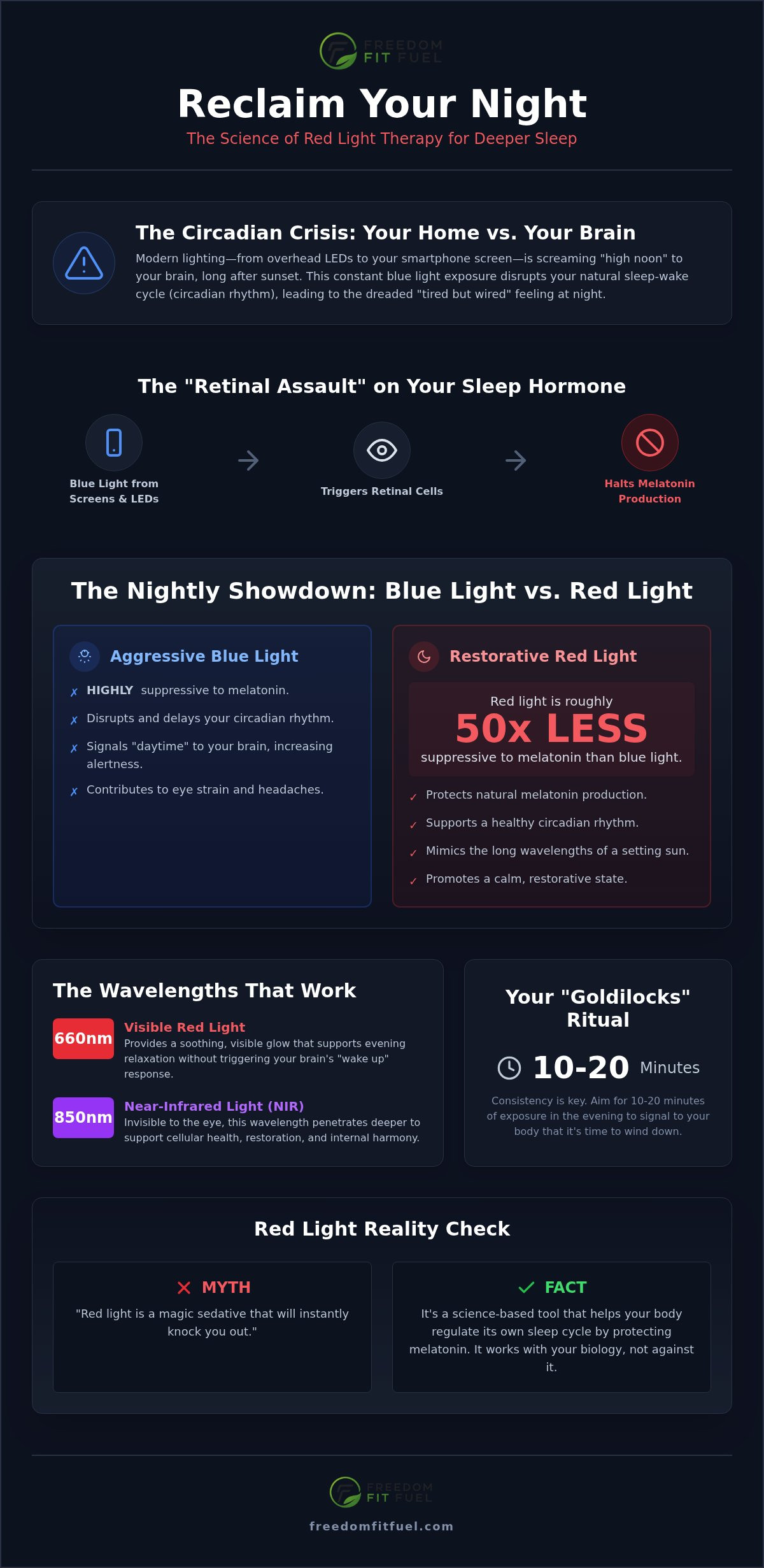
Your body operates on a biological metronome known as the circadian rhythm. For millennia, this internal clock followed the predictable rise and fall of the sun. Now, your high-efficiency LED bulbs are effectively lying to your brain every single night. These lights scream "high noon" when your soul is actually crying out for a pillow. This creates the "tired but wired" phenomenon, where your body is exhausted but your brain is still running a mental marathon because of evening light pollution.
Human biology evolved to recognize the warm, amber glow of a sunset as the ultimate permission slip to power down. Modern homes have replaced that soothing signal with harsh, artificial glare. Incorporating red light therapy for sleep acts as a biological reset button. It provides the light your eyes need to navigate without triggering the chemical alarms that keep you pacing at 2 AM. By mimicking the long wavelengths of a setting sun, you can signal to your system that the day is done.
Melatonin: The Vampire Hormone
Melatonin is often called the vampire hormone because it only performs its best work in total darkness. Its primary job is to initiate the complex architecture of your sleep cycle, but it's incredibly shy. When blue light wavelengths hit the melanopsin cells in your retinas, they send a direct message to your brain to stop production immediately. It's a literal retinal assault that happens every time you flip a switch after dark.
Your brain doesn't see a smartphone as a tool for checking emails or scrolling through memes. To your ancient biology, that iPhone is a tiny, glowing sun held six inches from your face. You're effectively staring into a supernova and wondering why your body won't just relax. It’s hard to wind down when you’re bathing your neurons in artificial daylight, effectively suppressing the very chemicals you need to drift off.
The Red Light Solution
This is where the concept of photobiomodulation comes into play. By using specific wavelengths, you can provide illumination that doesn't trigger the "wake up" response. It's helpful to understand The Science of Light Therapy to see how different colors affect our systems. While a standard red party bulb just makes your room look like a noir film set, a professional device like the Ultra Series Red & Near-Infrared LED Therapy Panel is designed with intentionality. It utilizes 660nm and 850nm wavelengths to support cellular health and restoration without the melatonin-crushing side effects of blue light.
Transitioning to red light in the evening restores a sense of quiet authority over your environment. It allows you to curate a space that values restoration, peace, and intentionality. By choosing a dedicated panel, you're not just buying a light; you're building a sanctuary that respects your biological needs. This simple shift moves you away from the high-pressure urgency of modern life and toward a more grounded, supportive nightly ritual. Using red light therapy for sleep is the first step in reclaiming your nights from the glare of the modern world.
Red Light vs. Sleep: The Science of Not Waking Up Your Retina
While blue light hits your retinas like a strobe light in a quiet library, red light is a gentle whisper. Scientific research into the "Melatonin Suppression Gap" reveals that red light is roughly 50 times less suppressive to your primary sleep hormone than the blue wavelengths emitted by your kitchen's overhead LEDs. This massive discrepancy is why red light therapy for sleep has become a non-negotiable pillar of modern light hygiene. It’s about being a thoughtful curator of your evening environment, intentionally choosing restoration over mindless stimulation.
Your skin and eyes contain specialized photoreceptors that are essentially light-sensitive switches. When you bathe your environment in the right wavelengths, you reduce oxidative stress and allow your nervous system to downshift. This shift moves you away from the high-pressure urgency of the day and toward a steadier baseline. It is a steady, methodical approach to wellness that respects your biological boundaries.
Wavelengths That Actually Work
The Ultra Series Red & Near-Infrared LED Therapy Panel operates with a specific synergy between 660nm and 850nm wavelengths. The 660nm red light is the "sweet spot" for evening relaxation, providing a visible glow that supports skin restoration and signals the brain to unwind. In contrast, the 850nm near-infrared light is invisible to the naked eye but offers deep tissue penetration to soothe physical tension. Photobiomodulation is the process where light energy triggers cellular healing. By combining these two, you create an environmental reset that is restorative, calming, and effective. If you are ready to transform your evening, you can explore the Ultra Series to begin your journey toward better rest.
The Mitochondrial Connection
Deep within your cells, mitochondria are working to produce ATP, the energy currency of your body. Red light stimulates these cellular powerhouses without the "stress" associated with high-energy blue light. When your cells have sufficient energy and low oxidative stress, your body can transition more smoothly into the complex stages of deep sleep. It is a natural evolution from being "wired" to feeling genuinely ready for repair.
Your cells are basically tiny batteries that need the right charger, not a lightning strike. Blasting them with blue light at 10 PM is like trying to charge your phone with a power line; it's aggressive, unnecessary, and frankly a bit rude to your biology. By using a supportive light source, you empower your body to recharge on its own terms. This rhythmic consistency in your evening habits helps build a reliable foundation for long-term health and vitality.
5 Real-World Examples of Red Light Rituals for Better Rest
Moving from the microscopic world of mitochondria to your actual bedroom requires a shift in intentionality. You don't need to spend hours bathing in crimson light; in fact, the "Goldilocks zone" for red light therapy for sleep is typically between 10 and 20 minutes. It's about consistency, not intensity. By turning your bedroom into a mindful sanctuary, you create a space that prioritizes your restoration over the high-pressure urgency of your digital world. Setting the stage for rest involves a few simple, steady shifts in your environment.
- The Home Office Transition: Use the panel for 10 minutes as you close your laptop to signal the end of the "work" brain.
- The Meditation Companion: Pair your red light session with a few minutes of mindfulness to anchor your evening.
The 'Sunset' Wind-Down
Position your panel on a stand for hands-free relaxation while you read a physical book 30 minutes before bed. This simple ritual signals your brain to release melatonin, unlike your phone which is basically a pocket-sized sun shouting at your retinas. Beyond just rest, this habit supports Red Light Panel Therapy: The Science of Cellular Rejuvenation. It's a sophisticated way to ensure you look refreshed while you actually get some quality shut-eye, replacing the frantic "doom-scroll" with a sense of quiet expertise.
The Post-Gym Evening Recovery
If you're hitting the weights late, your body is likely screaming for a cool-down that your brain isn't ready for. The Ultra Series Red & Near-Infrared LED Therapy Panel allows you to multitask by soothing sore tissues while keeping your eyes in "night mode." It’s the perfect bridge between a heavy squat session and a deep sleep session. You can learn more about Red Light Therapy for Muscle Recovery to understand how those wavelengths handle the physical grind. This helps you avoid the "tired but wired" feeling by addressing both cellular energy and nervous system tranquility simultaneously.
The Morning 'Reset' Ritual
While it sounds counterintuitive, your morning light exposure dictates your evening success. Using red light therapy for sleep to clear sleep inertia is a compassionate way to wake up without the retinal assault of harsh white bulbs. This ritual anchors your day with intentionality and actually primes your circadian rhythm for the next night. It’s a steady, methodical way to tell your body that the cycle has begun. By choosing this calming, restorative, and effective start, you ensure you aren't just reacting to the world's demands but are instead leading your own journey toward a more balanced and confident version of your daily life.
Red Light Therapy Myths: It’s Not a Magic Wand for Bad Habits
It is tempting to view wellness technology as a shortcut to bypass our less-than-ideal choices. However, red light therapy for sleep is not a sedative. It won't knock you out like a heavy dose of melatonin or a prescription sleep aid. Instead, think of it as a compassionate guide that helps your body find its own way back to equilibrium. It sets the stage, but you still have to walk onto it. If you’re drinking a double espresso at 4 PM and wondering why you’re still twitching at midnight, a red light panel isn’t going to save you from your own caffeine-fueled decisions.
There is also a persistent belief that a $10 red party bulb from a hardware store provides the same benefits as a professional device. This is simply not true. A colored bulb is just a filter that blocks other wavelengths. In contrast, the Ultra Series Red & Near-Infrared LED Therapy Panel is a precision tool designed for cellular interaction. It delivers specific, concentrated energy that a standard bulb cannot replicate. You aren't just looking for "red" light; you're looking for the biological resonance that triggers restoration. It is the difference between a curated experience and a cheap imitation.
The Intensity vs. Effectiveness Debate
In the wellness world, we often fall into the "more is better" trap. Blasting yourself with red light for two hours won't make you twice as sleepy; in fact, it’ll likely do the opposite. This is due to the biphasic dose response. There is an optimal window where light therapy is beneficial, but exceeding that window can lead to over-stimulation. Your cells need a gentle nudge, not a high-pressure fire hose of energy. For evening use, we recommend keeping the panel at a comfortable distance or using a lower intensity setting. This ensures the experience remains calming, supportive, and restorative rather than becoming another source of stress for your nervous system.
Red Light is a Tool, Not a Cure-All
We see ourselves as your partner in this journey toward better living. A high-quality panel is an essential part of your toolkit, but it isn't the entire team. To truly fix your circadian rhythm, you need a holistic approach that includes a cool room, a consistent schedule, and a break from digital screens. A red light panel is incredibly effective at protecting your melatonin, but it still can't stop your neighbor's dog from barking at 2 AM or pay your taxes for you. It is a powerful ally that empowers you to take control of your environment and find your own sense of quiet authority.
When you use red light therapy for sleep as part of an intentional routine, the results are transformative. It’s about building a sustainable lifestyle that values quality, trust, and deep purpose. If you are ready to invest in a device that respects your biology, shop the Ultra Series and start curating your own sleep sanctuary today.
Designing Your Sanctuary: Choosing a Full Body Red Light Panel
Choosing the right hardware is the final step in moving from a state of biological chaos to one of intentional restoration. While a tiny desk lamp might look cute on your nightstand, it's about as effective for systemic health as using a birthday candle to heat a master suite. To truly leverage red light therapy for sleep, you need an environmental shift. A full-body panel doesn't just point light at you; it bathes your entire system in the wavelengths required to signal safety to your nervous system. This immersive approach is what separates a fleeting gimmick from a life-changing wellness protocol.
When selecting a panel, your criteria should be as sophisticated as your sleep needs. In a sleep sanctuary, you must prioritize low EMF output and flicker-free technology. High EMF levels can be counterproductive to the calming environment you're trying to build, while invisible light flicker can cause subtle eye strain and neurological fatigue. You're looking for a partner in your growth, not a source of more digital noise. Investing in a professional-grade tool ensures that your evening ritual remains a steady, methodical conversation with your biology rather than a high-pressure interrogation.
Why Size Matters for Sleep
Full-body coverage is essential for addressing systemic issues like inflammation and skin rejuvenation across your entire frame. By creating a literal "cocoon" of light, you provide a consistent signal to every cell in your body that the day's high-pressure urgency has ended. This broad application is why many users find it far more effective than targeted devices that only hit a small patch of skin. For a deeper look into the technical specifications, you can explore The Ultimate Guide to Red Light Therapy Panels for Home Use. It’s about building a foundation of quality and trust in your daily habits.
The Ultra Series Advantage
The Ultra Series Red & Near-Infrared LED Therapy Panel is designed to be the centerpiece of your restorative sanctuary. It combines the dual-wavelength capability we discussed earlier into a single, cohesive unit that fits seamlessly into a sophisticated home aesthetic. You don't have to choose between professional-grade recovery and a beautiful living space. This panel provides a curated path toward better rest, acting as a supportive mentor that values your time and your health. It is a premium solution for those who are ready to move beyond the "zombie" phase of their lives and reclaim their recovery.
Making an investment in your sleep is, at its core, an investment in your daily vitality and long-term confidence. You can't show up as the best version of yourself if you're constantly fighting a 3 AM internal battle with your own brain. It is time to treat your rest with the same intentionality you bring to your career or your fitness. If you are ready to stop the retinal assault and start the healing, Discover the Ultra Series and reclaim your night. Your future, well-rested self will thank you for finally taking red light therapy for sleep seriously.
Reclaim Your Night and Restore Your Rhythm
You've spent long enough letting your smartphone's blue glare dictate your biological clock. It's time to stop the retinal assault and start listening to your body's need for restoration. By integrating red light therapy for sleep into your evening, you provide your brain with the sunset signal it has craved for millennia. You're not just buying a light; you're investing in the cellular energy required to wake up feeling like a human again rather than a hollowed-out shell of your former self. Consistency is the secret ingredient that turns a simple habit into a life-changing ritual.
We are here to act as your partner in this evolution toward better living. We provide professional-grade recovery tools, supportive expert-led guidance, and high-quality, low-EMF technology designed for your sanctuary. It's time to move toward a more balanced and confident version of your daily life. Upgrade your evening ritual with the Ultra Series Red & Near-Infrared LED Therapy Panel and embrace the deep, restorative rest you deserve. You possess the power to curate a life that feels intentional, balanced, and vibrant.
Common Questions About Red Light and Rest
Does red light therapy actually make you sleepy?
Red light therapy doesn't work like a synthetic sedative; it won't force your eyelids shut the moment you flip the switch. Instead, it creates a supportive environment that allows your body's natural sleep signals to function without the interference of artificial blue light. It's about removing the biological roadblocks that keep you awake. Think of it as a gentle nudge toward tranquility rather than a chemical hammer to the head.
Can I leave my red light panel on all night while I sleep?
You shouldn't leave your panel on all night. While red light is significantly less disruptive than other colors, your brain still requires total darkness to enter the deepest, most restorative stages of the sleep cycle. Use the Ultra Series as a wind-down tool for 10 to 20 minutes before you crawl into bed. Once it's time for actual shut-eye, turn off all the lights and let your biology take the lead.
How long should I sit in front of the red light panel for sleep benefits?
Consistency is far more important than duration. Aim for a 10 to 20 minute session during your evening wind-down ritual. This "Goldilocks" zone provides enough light to signal your mitochondria and nervous system without causing over-stimulation. If you're using red light therapy for sleep, try to keep the panel at a comfortable distance. Standing there for an hour won't make you sleep twice as well; it just makes you a very well-lit night owl.
Is red light therapy safe for my eyes if I use it in the evening?
Red light therapy is generally considered safe for the eyes, but you should never stare directly into the LEDs for extended periods. The gentle, warm glow is designed to bathe your environment, not act as a high-intensity laser show for your retinas. If the light feels too bright during your evening session, simply close your eyes or move the panel further away. It's about finding a balance that feels restorative rather than aggressive.
What is the best wavelength for red light therapy sleep benefits?
The most effective wavelength combination involves 660nm red light and 850nm near-infrared light. The 660nm visible red light is perfect for skin restoration and environmental signaling, while the 850nm wavelength penetrates deeper to soothe physical tension. The Ultra Series Red & Near-Infrared LED Therapy Panel uses this specific dual-wavelength logic to support total body restoration. Using these targeted frequencies ensures you're getting a professional-grade experience rather than just sitting under a cheap, ineffective red bulb.
Does red light therapy increase melatonin production?
Red light therapy doesn't technically "create" melatonin; it protects your natural supply from being suppressed by blue light. By using red light therapy for sleep, you're preventing the "retinal assault" that tells your brain to stop producing sleep hormones. It allows your pineal gland to do its job without being bullied by your smartphone or overhead LEDs. It's a supportive partnership with your existing biology rather than a synthetic replacement for it.
Can red light therapy replace my morning coffee?
It's unlikely to replace your favorite espresso, but it can certainly help you clear the morning fog. Using red light in the morning is a compassionate way to wake up your cells without the jarring shock of bright white light. It primes your circadian rhythm for the entire day, which actually sets you up for better rest the following night. It's about building a steady, methodical rhythm that values long-term vitality over a quick caffeine spike.
Will a red light panel help with insomnia?
A red light panel is a powerful tool for improving sleep hygiene, but it's not a clinical cure for chronic insomnia. If your sleeplessness is caused by light pollution or a disrupted rhythm, it can be transformative. However, it can't fix underlying medical issues or the fact that your brain is replaying an embarrassing moment from 2012. Use it as part of a holistic sanctuary that prioritizes peace, intentionality, and deep, restorative self-care.